
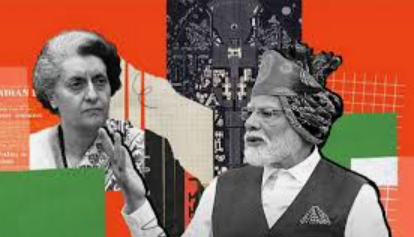
25th June 2025 marks the 50th anniversary of declaration of Emergency that lasted for 21 months. In retrospect, it can be seen that Indira Gandhi’s Emergency declaration was her last resort to continue exercising full executive powers as prime minister, following judicial verdict on her alleged electoral malpractices. Obviously, under the fascist regime today where the Election Commission itself has become an appendage or a tool of the Executive, such a judgement from judiciary is well-nigh impossible, as evident from allegations of unprecedented rigging in Maharashtra elections.
No doubt, prime minister Indira Gandhi’s imposition of the Emergency was no less than a constitutional crime committed for purely personal reasons, i.e., to continue as prime minister. Under the cover of Emergency, Indira could put Communist revolutionaries and her political opponents behind bars, impose press censorship, suspend the fundamental rights, attempt to give herself immunity from criminal proceedings, and so on. Until the withdrawal of Emergency on 21 March 1977, together with a ‘coterie’, Indira ruled by decree, converting India into a police state. However, in view of the loosening grip of the regime over the vast Indian society and on account of the lack of popular and societal support, she had to withdraw the Emergency of almost two years followed by declaration of General Election leading to the rout of the ruling Congress!
However, as usual, the broad political spectrum in India ranging from far-right RSS/BJP fascists on the one extreme to the social-democratic CPM (which is often called apologists of fascism) on the other end, are espousing their standard narrative of identifying Emergency with ‘fascism’. And, it is an irony of history that the BJP regime which observes June 25 every year as ‘Samvidhan Hatya Diwas’, has already undermined or altered the very character and structure of the Constitution by keeping the parliament as a mere edifice or spectator, which the Indira regime was incapable to accomplish during the 21 months of Emergency. No doubt, by equating Emergency with fascism, both fascists and their apologists, though from different orientations, are depoliticising fascism itself. It’s outcome is a whitewashing of the horrors of the present Indian fascist regime under BJP whose ideological-political mentor is RSS, world’s biggest and longest-running fascist organisation.
Since this is a much-discussed issue at various levels (see, for instance, the links attached below), this note is only to reiterate the position that Indira’s short-lived Emergency or authoritarian rule was not fascism from an objective historical perspective on its genesis and transformation at a global level over a century. Rather, equating the two years of Emergency with fascism in gross disregard of its material and ideological prerequisites, is too subjective, superficial and devoid of a meaningful evaluation. In essence, the material basis of fascism everywhere is the most corrupt and most reactionary corporate financial oligarchy which merges itself with the far-right fascist regime. However, depending on the historical and social structures of countries, the ideological basis of fascism along with anti-Communism and Islamophobia (under post-Cold War neoliberalism) is country-specific. That is, Manuvadi Hindutva or ‘political Hinduism’ in India, Evangelism in America, xenophobia, ethno-nationalism and neo-atheism in Europe, Zionism in Israel, political Islam in Middle East and even neo-Buddhism in Asia, etc., can form the ideological basis of fascism today (or neofascism) according to the concrete situation of countries.
To be precise, unlike the Indian fascist regime today, whose political-economic base is most degenerated and decadent crony capital, and ideological base being Mauvadi Hindutva for which Muslims are number one enemy, Indira Gandhi’s authoritarian regime lacked such an essential and badly needed material-ideological basis of fascism. For instance, such apparently progressive initiatives as Bank Nationalisation, abolition of Privy Purse, Acts like MRTP and FERA, and her slogan of “Garibi Hatao”, which were part of the Nehruvian state-led development paradigm had totally alienated the far-right pro-American sections of Indian corporate big bourgeoisie from Indira Gandhi. This also compelled her to withdraw the Emergency within two years. And, after returning to power in 1980, Indira made a U- turn and, as per US-diktats surrendered to IMF’s most stringent, far-right, neoliberal conditionalities on the one hand, together embracing a ‘soft-Hindutva’ orientation and compromising with RSS, on the other. To be precise, both Emergency and post-Emergency policies of Indira Gandhi laid the foundations for the declining phase of Congress which had been the pan-Indian ruling party for more than a quarter century following Transfer of Power.
RSS, the Ultimate Gainer from Emergency
While Emergency inaugurated the declining phase of Congress, India’s ‘grand old party’, it was the same Emergency that enabled the sudden and dramatic shoot-up of RSS from relative obscurity to the political lime-light. The dictum that fascists are very adept in transforming crises into opportunities is most suited in the case of RSS. While Modi and Hindutva leaders always project Emergency as a ‘dark period’, it was true for the people, while the same was a godsend opportunity for RSS, that laid down the conditions for its entry into the political mainstream and legitimise itself to be transformed into world’s biggest and longest-running fascist organisation. Obviously, in the background of the Indo-Soviet Treaty and close alliance with “social- imperialist” Soviet Union, the latter firmly supported the Emergency. On the other hand, and quite logically, US think-tanks and Western imperialist circles vehemently opposed Emergency. Consequently, as the parliamentary Indian Left became apologists of Emergency (then CPI(M) General Secretary P Sudarayya resigned due to this), with the support of western media, the pro-American RSS came to the forefront of opposing Emergency that led to its ban, but significantly boosting its profile and expansion in the process. Though it is not intended here to go into those details, after a while, led by its chief Deoras, the RSS compromised with the Indira regime, and on the basis of unconditional undertakings to the government, a large number of RSS leaders and cadres came out of prison, even as deepening and broadening it’s covert activities, while ban on Communist revolutionaries continued. After the Emergency, during the 2 years of Janata government, many RSS cadres became central ministers providing RSS an opportunity for the first time to make use of government machinery for its Hindutva agenda. After the collapse of the Janata regime, the RSS replaced Jana Sangh with BJP as its new political tool, and within a span of two decades, the first BJP regime came to power led by Vajpayee (Details of the process are in the link given below).
The upshot of the argument is that the commemoration of Emergency, characterizing it as the “darkest period” in India’s democratic history by the entire Sangh Parivar and a whole set of liberals including those who were apologists of Emergency, is a diversionary tactic or to cover up the horrors of RSS fascism in India today. Unlike Indira’s Emergency regime, the RSS which controls state power through its political tool BJP today, is also controlling street power and has its stranglehold over the entire micro and macro spaces of the country through the innumerable open and secret organisations under its umbrella. The corporate-Hindutva fascist tentacles have already penetrated into civilian administration, military, judiciary, education, culture, science, research and even history writing. And in the maddening pace towards RSS’ ultimate objective of establishing a majoritarian Hindu Rashtra, the fascist regime has been taking all efforts to make Muslims second class citizens, where vast majority of the working people from oppressed castes such as Dalits and women will be condemned as subhuman according to the tenets of Manusmriti, the ideological guideline of RSS.
And, under the far-right, pro-corporate policies of fascist Modi regime, India’s wealth and resources are gobbled up by a handful of crony-corporate billionaires like Adani and Ambani and global MNCs. While the number of billionaires is going up and their wealth appropriation is sky-rocketing, with more than 50 percent of the world’s absolute poor, India has become one of the most unequal and corrupt countries inhabited by the largest chunk of jobless and informal workers. The constitutional amendments and series of draconian laws superimposed by more than a decade of Modi rule have already altered a the very character and structure of the Constitution, while snatching away hard-earned democratic rights of people. Dissent, protests, and opposition to these fascist policies are stamped as anti-national or illegal.
To conclude, while commemorating the 50th anniversary of Emergency, all anti-fascist and democratic forces should be cautious not to fall into the trap of a diversionary tactic of equating Emergency with fascism or identifying RSS fascism as undeclared Emergency.
Links:
https://countercurrents.org/2023/06/june-25-48th-anniversary-of-emergency-equating-fascism-with-undeclared-emergency-is-depoliticisation/
https://countercurrents.org/2025/02/cpi-ms-reluctance-to-categorise-modi-regime-as-fascist/
