
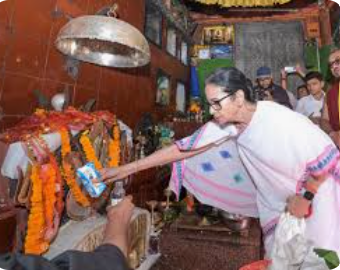
Mahakal Temple: In the Race to Build Shiva, Mamata Builds a Monkey
Shankar
Before the cement at Digha’s Jagannath Temple even had a chance to dry, Mamata Banerjee announced that the next Mahakal temple would be built in Siliguri. The vote-bound state has become preoccupied with religion. As the BJP’s assertion of Hindutva intensifies, Mamata Banerjee’s competitive embrace of Hindutva is likewise increasing. The Trinamool Congress lacks the capacity to mount an effective political challenge to the BJP; instead, in an effort to defeat BJP, TMC is trying to capture its votes in religious line, the Trinamool has further degraded West Bengal’s political environment. What could be more grotesque than a state, already beset by unemployment and losing millions of working people who migrate to other states in search of jobs, whose share of national output is falling behind and whose debt burden is rising toward the stratosphere, proceeding to build temple after temple? It is difficult to imagine a more ignoble spectacle.
Most important is this paradox: in attempting to contain the BJP, Mamata Banerjee is legitimizing and implementing many of the BJP’s odious policies and trying to surpass the BJP by adopting the same playbook. Whether she and her party understand the implications is doubtful, but the effect is that the BJP benefits politically. If the BJP’s policies continue to become entrenched in this fashion, there will come a moment when voters will prefer the original BJP over ersatz imitations. It is likely that Mamata and her circle do not possess the political insight to foresee this.
The success of a state and its government should be measured by how far they secure for their citizens the fundamentals of livelihood: education, health, housing, safety, and democratic freedoms. It is well known that since coming to power, the Trinamool Congress has neglected these core responsibilities. Unemployment is a pressing problem in the state. From many districts millions of young men have migrated outward. According to 2023 figures, nearly 1.5 million Bengali workers are in Kerala alone. The 2011 census showed about 2.9 million workers from the state employed as migrant laborers in other states; since then hundreds of thousands more join them each year. Altogether, approximately 3.5 million workers from the state currently work in other states—and that number increases daily. Recent incidents in BJP-ruled Odisha and in northern BJP-ruled states—where Bengali workers were labeled as Bangladeshis, arrested, abused, beaten, and in some cases forcibly deported—provoked widespread outrage. In response, the West Bengal chief minister announced that returnees to the state would receive a monthly allowance of five thousand rupees: an initial one-time payment of five thousand rupees, followed by five thousand per month until they find new employment. She gave the scheme a florid name—“Shramshri”—but her government has no coherent policy for creating dignified, sustainable employment. There is no plan. The Trinamool government has now been in office for fourteen years; their continued failure to address these matters is an unforgivable dereliction.
Meanwhile, corruption has reached extreme levels. Public-sector recruitment examinations have become nightmarish. Ministers and leaders accused of corruption spend days in jail. The picture is the same in education and health. The private sector has flourished everywhere while public hospital systems have been progressively degraded under Trinamool rule. Hospitals have become hubs of malpractice. Doctors who have protested corruption have themselves been subjected in hospital settings to rape and even murder. The market in dead bodies, fake medicines, and expired drugs is rampant; innumerable other illicit, shameful trades persist. Private hospitals and nursing homes have exploited and plundered patients. Contractual employment has proliferated nationwide, but in West Bengal it appears to have shattered all previous records. From police forces to healthcare workers, from college and university lecturers to municipal sweepers, contractual recruitment dominates. The extensive corruption and malfeasance in hospitals are repeatedly linked to the treatment of contract employees. Disturbing reports have even emerged of a security guard employed at one public hospital entering another hospital disguised in a doctor’s coat and participating in sexual assaults.
Education, too, has become a site of disorder. Enrollment in government and semi-government schools has declined considerably; the government seems unconcerned. Rather than strengthening public education, authorities have closed clusters of schools. Budgetary allocations to education have shrunk. The Mid-Day Meal program is faltering; in many places substandard food is supplied under the scheme. For months on end universities have had no permanent vice-chancellors. Educational institutions have become arenas for the assertion of power and dominance—an objective that, like the BJP, the Trinamool now appears to pursue. Consequently, the future of the public education system in the state is increasingly insecure under both the BJP and Trinamool.
Amidst all this, yet another temple is to be constructed with state funds. As with the Digha project, public money will be spent. The Digha Jagannath Temple reportedly cost ₹250 crore. The exact budgetary allocation for the proposed Mahakal Temple remains unclear, but it is reasonable to assume that it will not receive less allocation than the Jagannath Temple.
First, West Bengal is a state with acute fiscal constraints. The government must borrow substantial sums each year simply to maintain operations. In 2023–24, the ratio of the state’s total debt to its GSDP was approximately 34.2 percent; it has since risen toward 39 percent. According to the 2023–24 financial-year budget, the state’s total debt stood at roughly ₹5.86 lakh crore; by the close of 2024–25, estimates in the budget presented by the present government project the debt could rise to about ₹6.5 lakh crore. The Fifteenth Finance Commission of India recommended that states keep this ratio under 20 percent. West Bengal is evidently far from that target. Moreover, a significant portion of the debt services old loans and interest. A large share of the state’s revenues—on the order of ₹40,000–50,000 crore per year—goes merely to interest payments on past debt. Consequently, little remains for developmental expenditure on education, health, roads, drainage, and so forth. Although the state government claims GSDP growth in recent years has exceeded the national average (approximately 6–7 percent), allegedly approaching 8–10 percent, the plausibility of these claims is doubtful; even if they were accurate, they would still be insufficient to sustain government expenditures given the debt-to-GSDP ratio. In short, the state’s economy is in decline. It is astonishing that the government can justify spending hundreds of crores on temple construction in such circumstances.
Second, in a secular republic such as India the state should maintain a safe distance from the construction of temples, mosques, and other religious undertakings. There must be no entanglement of religion and state—that is the principle of secularism. Yet since independence this principle has rarely been applied rigorously. Where political expediency permitted, the Congress linked official functions to religious rituals. Inaugurations were sometimes accompanied by Hindu rites; ministers and party leaders were frequently seen at Iftar parties when Muslims broke their fast. Under the BJP these practices have been pursued more openly and assertively, reflecting their programmatic promotion of Hindu religious activities. Two distinctions separate Congress and BJP practices: first, BJP leaders actively perform and sponsor Hindu rites and institutionalize Hindu religious activities; second, the BJP is the only major political force that has taken an explicit theoretical position against secularism. This is a bold departure from previous norms and places the party in a category of overt majoritarian Hindutva—indeed, tendencies that can be characterized as fascistic in their scale and audacity.
Fascist parties do not exist in isolation; there are parties that surrender to fascism’s pressures. In India, among the parties that have capitulated to BJP policies, the Trinamool Congress increasingly presents itself as a leading example. As Modi’s leadership consolidates a form of authoritarian governance across India, the political criminality inherent in adopting, implementing, and attempting to outdo the BJP’s Hindutva agenda is grave. Mamata Banerjee and her colleagues do not seem to perceive this. Should they ever do so, there may be no political refuge left for them.
The Ram Temple in Ayodhya was constructed under a trust structure set up by the BJP rather than through direct state funding. By contrast, the Digha Jagannath Temple was built with direct state funds and under the chief minister’s explicit supervision. The proposed Mahakal Temple will follow that same model. The chief minister’s public declaration—“I will build a Mahakal temple; I will build the largest Shiva idol”—disregards the normative constraints of modern state governance. The situation is so absurd that even BJP leader Sri Shubhendu Adhikari felt compelled to remark that building a temple with personal funds is one thing, but constructing one with government money is not the government’s role. Different observers will judge Adhikari’s remark differently. Mamata may take pride in having placed the BJP in a difficult position over Hindutva competition. But defenders of democratic norms will say that secularist rhetoric from the mouths of fascistic Hindutva proponents is like a pearl necklace on a monkey—and Mamata herself has placed that necklace around the monkey’s neck. The monkey is dressed before the god is sculpted. In this manner, instead of effectively resisting the BJP, Mamata Banerjee and her cohort are paving the way for a future in which a sectarian, Hanuman-centric polity may be established.
(The article was originally published in Nagorik.net in bengali.)
