
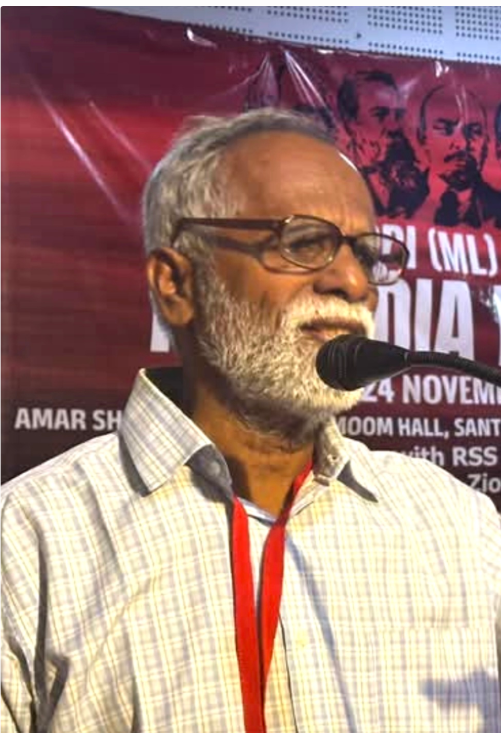
As part of a renewed effort to build our international relations, the aim of which is to put Italian comrades in touch with the most advanced points of view and analysis developed by communists, socialists and anti-capitalists from all over the world, we publish a long interview with PJ James, General Secretary of the Communist Party of India (ML) Red Star.
We believe that the extraordinary richness and analytical depth of his answers can offer useful insights for understanding the current situation of a country, India, whose developments will have a profound impact on the future of Asia, and therefore of the world.SS
The impression one gets, observing the evolution of the Indian political framework from the outside, is that of a rapid transformation of the country in an authoritarian direction, driven by the Sangh Parivar galaxy of which Prime Minister Narendra Modi’s BJP party is a filiation. How does this evolution manifest itself in the concrete life of the country?
Since 2014, under the BJP government led by Narendra Modi, India, the world’s most populous country, has been a typical example of 21st-century fascism or neofascism, i.e. fascism under neoliberalism which, of course, is not a true copy of classical fascism. The BJP, the world’s largest political party that leads the Indian regime, is a political tool of the RSS (Rashtriya Swayamsevak Sangh), the largest and longest-running fascist organization in the contemporary world. With its countless extensions and overseas affiliates such as the HSS (Hindu Swayamsevak Sangh), the VHP (Vishwa Hindu Parishad) and others, which fall under the great umbrella of the “Sangh Parivar” (Family of the Sangh), the RSS has extended its tentacles to 156 countries around the world. While the centenary celebrations of the RSS are taking place in India with the full support of the Modi regime, it has reportedly reached the goal of 100,000 shakhas (sections) across India.
The founding of the RSS in 1925 was contemporary with the classical fascism associated with both Mussolini and Hitler, and maintained close ties with them throughout the 1920s and 1930s. In this sense, the RSS represents the only fascist organization in the world with a historical continuity that goes from the colonial period to the neocolonial-neoliberal phase of imperialism. With its ultimate goal of establishing a majority Brahmanical Hindu Rashtra (Hindu nation), the “cultural nationalism” of the RSS, since its very inception, has been the camouflage of extreme subservience to Britain, when India was its colony, and dependence on the United States in the period of post-war neocolonialism. In other words, the RSS was never part of the anti-colonial struggle and, after Britain’s formal withdrawal in 1947, the RSS conceded its absolute allegiance to US imperialism. Like its Zionist counterparts, the extreme right subservient to international monopoly capital represented by the RSS also exercises a flourishing lobbying activity in the United States, through the Republican-Hindu Coalition, Overseas Friends of BJP and other structures.
The demonstrations of RSS fascism in India are truly horrible. The entire political, economic, administrative, judicial, military, cultural and educational sphere of India is in the fascist grip of the RSS. And state power is not enough: much like Mussolini’s blackshirts and Hitler’s brownshirts, the RSS thugs (also called Sanghi or Saffron) control street power in India. To be precise, the entire micro and macro sphere of Indian society today is under the firm grip of RSS fascism. When RSS thugs unleash terror, including lynching “untouchable” Dalits and minority religious communities, especially Muslims and Christians, law enforcement agencies often remain inert bystanders, when they do not openly support fascists. Political decisions are dictated by neoliberal centers (the IMF-World Bank-WTO trio) or taken in the offices of the RSS and in the boardrooms of the most corrupt monopoly billionaires, directly connected with the fascist regime through the most sordid constraints, while the parliament remains an empty shell or a mere spectator. While the Modi regime promotes India as the “Mother of Democracy”, freedom of speech and expression are restricted under the guise of national security and through draconian laws.
The government’s discriminatory policies against the Muslim minority, which, it should be remembered, in India numbers over two hundred million people, are becoming increasingly evident. How do these discriminations manifest themselves and what forms of contrast are developing on the part of the Indian democratic forces?
According to the most recent estimates, out of 1,470 million inhabitants in India, 202 million are Muslims and 32 million are Christians. According to Hindutva, or “political Hinduism,” which constitutes the central ideology of the RSS, the number one enemy of the Hindu nation is Muslims, the second is Christians, and the third is Communists. It is revealing that Golwalkar, the main leader of the RSS who took over the leadership in 1940, was at the time an admirer of the anti-Semitism of German fascism, including the Nazi method of “purifying” society of so-called “inferior races”, mainly Jews. And Golwalkar suggested the same Nazi method as a good example for India to solve the “Muslim question.” More to the point, while US-led imperialism has adopted Islamophobia (along with the usual anti-communism) as the ideological basis of post-Cold War neo-fascism, for the RSS Islamophobia has been the ideological foundation since colonial times.
Since 2014, when the RSS, through its political instrument BJP, took the reins of the Indian regime, the structure and character of the Indian Constitution have been systematically weakened through the introduction of religion as a criterion for Indian citizenship. For example, the Citizenship Amendment Act (CAA) of 2019, for the first time, enshrined the selective position of denying Muslim migrants access to Indian citizenship. Now, after transforming the Electoral Commission into an appendage and a flexible instrument of the executive (Modi regime), millions of Muslim voters are being removed from the electoral rolls under the so-called Special Intensive Revision (SIR), thus systematically depriving them of the right to vote. In continuity with the demolition of the Babri Masjid in 1992 (destruction of a mosque in Ayodhya by a mob of Hindu activists, an event that triggered serious interreligious violence in India, Ed.), the Modi regime built the temple of Rama (the main Hindu deity) on the very site of the demolished mosque, and Modi, as prime minister, he assumed the role of high priest there. Now, across India, mosques and Muslim settlements are being demolished and erased with the support of the fascist regime and its police, while the judiciary remains silent. Those who protest are imprisoned using anti-sedition laws. And all the constitutional protections guaranteed to Muslims are progressively removed through stigmatization, deprivation of political rights and denial of citizenship. Although the protests emerge in various forms, the Modi regime represses them with extreme harshness, through repressive laws.
Our Party is at the forefront of ongoing campaigns and protests against RSS fascism in a number of ways. As part of this, on December 6, 2025 (the anniversary of the demolition of the Babri Masjid), we held a National Conference Against Fascism RSS together with organizations from Muslim and Dalit oppressed communities, and the Party, alongside its long-term strategic tasks, is taking up this struggle against fascism as an immediate task in today’s India.
How do you assess the impact of the recent economic and labour market reforms led by the Modi government on the urban and rural working classes?
India has about 650 million workers distributed between agriculture (41%), industry (26%) and services (33%). Unemployment is very high, even among young people (aged 18–30), and exceeds 10%. Of the total workforce, more than 94% fall into the informal/unorganized category. In addition, globalization, liberalization and privatization under neoliberal corporatism are pushing more and more workers towards precarization and undeclared work.
With the intensification of far-right neoliberal policies since 2014, Modi’s pro-monopoly regime, illicitly in cahoots with the most corrupt crony capitalists and junior corporate partners from imperialist countries, has systematically stripped the Indian working class of all the rights hard-won through decades of struggle. For example, since colonial times India had a series of labor laws guaranteeing minimum wage, 8-hour workday, employment guarantee and social security, which received further reinforcement under the developmentist state by Nehru, as part of the “welfare state” that US-led imperialism maintained as an ideological weapon against communism until the 1970s. However, the collapse of the Keynesian welfare state in the 1970s and the subsequent adoption of neoliberalism, which conferred unlimited freedom on monopoly capital, also had repercussions in neocolonial India, leading to its complete integration into the flows of international finance capital.
One of the effects was the imposition by the Modi regime of the notorious labor reforms, in the form of four labor codes that completely replaced the 44 laws inherited from the “Nehruvian model.” This measure completely liberalized the Indian labor market according to IMF-World Bank directives, making India compliant with the requirements of “easy of doing business” and “favorable to investors” (i.e. multinationals). As a result of the internationalization of capital and the consequent new international division of labor, including the global relocation of production, India, with its inexhaustible labor force, has become one of the cheapest sources of production for multinational corporations and their subordinate Indian partners such as Adani, Ambani, Tata, Birla, etc. This has also led to an unprecedented extraction of surplus value and a super-exploitation of the Indian working class, increasingly driven towards unprotected undeclared work.
The effect of the rapid global progress of so-called “frontier technologies”, including digitalisation, robotisation and artificial intelligence, on the Indian working class is that it is becoming increasingly disorganised and submerged, with no distinction between urban and rural society. In addition, due to the corporatization of agriculture led by the WTO, which leads to the expropriation of farmland and the abandonment of the countryside, India is experiencing one of the largest internal migrations in history, in which more than 100 million workers without means of subsistence are forced to survive in the underground economic sectors and migrate to urban centers, crowding into ever-expanding slums. Of course, as a consequence of the increasing integration with the international financial economy, the productive sphere is also relatively stagnant in India while the speculative sphere thrives, leading to international reports that indicate India as one of the most corrupt countries in the world.
How is the political framework described here affecting the survival of the caste system in Indian society? What movements are developing within it for the destruction of the caste system?
The caste system is a peculiarity of South Asia in general and, more specifically, of India. India’s caste system is the world’s most inhumane social institution, treating the vast majority of India’s working people as “subhuman,” meaning they are even below animals in terms of dignity. The system divides people into four castes: the Brahmins (the divine or priestly class, superior to all others, almost on a par with God), the Kshatriyas (the warrior class from which kings come and who must serve the Brahmins), the Shudra class (made up of merchants and businessmen) and the Dalits, who are the “untouchables” and are forced to serve the other castes through unpaid and bonded labor, always keeping an established distance from them. The Indian caste system is both the ideological and material basis of the fascism of the RSS, which identifies the Indian nation itself (Hindu nation) with the caste system. According to Manusmriti, the ideological reference text of the RSS, untouchable Dalits and women are subhuman and deprived of any human rights. Today, Dalits include agricultural workers, informal workers, manual waste removal workers, sewer workers, rag pickers, and other manual and unskilled workers. According to caste rules or the Manu code, Dalits cannot own land, wealth, education, art, literature and must remain on the margins of society.
With the emergence of the anti-caste movement and the sincere efforts of the greatest leader of the Dalits, Dr. Ambedkar, some principles and actions have been included in the Indian Constitution, such as caste-based reservation in public workplaces and the provision that untouchability is a criminal offense, etc. However, the caste system is still entrenched in Indian society and Dalits, with a few exceptions, are always on the margins of society, although the fascist RSS-BJP parties (and other non-fascist ruling class parties, including some left-wing parties) are trying in every way to co-opt and assimilate Dalit organizations and their leaders into the support base of Hindutva (i.e. political Hinduism) and to secure electoral advantages. Despite reservations, only about 1% of bureaucratic posts are still accessible to Dalits (Scheduled Castes and Scheduled Tribes, as referred to in the Indian Constitution), while they make up almost 25% of the Indian population. Brahmins, on the other hand, who make up 3% of the population, occupy more than 60% of high-level bureaucratic posts and, including the Kshatriyas, the top 10% of the population hold 80% of top bureaucratic positions. Other Backward Classes (OBCs), Muslims, Christians and Dalits, who together make up about 90% of the population, have only 20% of government posts.
Of course, it is necessary to state self-critically that the Indian communists, from the right-wing reformists to the left-wing sectarians, have totally failed to approach the caste question in the correct Marxist perspective. Although he had only second-hand information about Indian society from colonial writings and documents, Marx had specifically mentioned the Indian caste system in almost all of his works, such as articles for the New York Daily Tribune, For the Critique of Political Economy, Capital, and, above all, in the Ethnological Notebooks, which, written between 1880 and 1882, they were compiled and edited by Lawrence Krader in 1972, in which Marx provided a detailed analysis of non-Western societies. Also with regard to his analysis of the “mode of production”, Marx believed that the “capitalist mode of production” he had elaborated for Europe was not applicable to non-European societies. According to Marx, “there is no general path of development prescribed for all nations.” It is in this context that Marx conceptualized the “Asian mode of production” (formerly “Eastern despotism”) with reference to Indian caste-marked society. And for more than a decade, from 1919, the Comintern also held this Marxist position with respect to non-European societies. In line with this, the Communist Party of India (ICC), founded in 1920, also held the same position, as evidenced in the Draft Platform for Action published in 1930, in which the CPI unambiguously stated that even minimal democracy in India requires the abolition of caste.
However, the Leningrad discussions of 1931 abandoned that Marxist understanding and, under pressure from Soviet Russia, neglected the specific and concrete realities of oppressed peoples in non-Western societies. On the contrary, under the pretext of an exclusive ideological focus on class struggle, they adopted a rigid and mechanistic approach, including a unilinear position on historical development, rejecting the socio-economic structures peculiar to non-Russian societies, including the Indian caste system and the Marxian conceptualization of the Asian mode of production, the solid basis of which, according to Marx, it is caste. When the Comintern began to propagate this Russian position in total disregard of the earlier Leninist slogan “proletarians and oppressed peoples of the world unite”, adopted at the Second Congress of the Comintern on Lenin’s initiative, Mao Zedong adopted a different approach, in line with the concrete reality of China, leading to the success of the Chinese Revolution in 1949. On the contrary, under the influence of the Soviet Union and the British Communist Party, instead of developing a class analysis appropriate to Indian caste-marked society and thus applying Marxism-Leninism to India’s concrete conditions, the CPI abandoned the Marxist caste approach and rejected Marx’s Asian mode of production, as outlined in its 1930 Draft Platform. As a result, the CPI also abandoned its own unity with the initiatives of the oppressed castes of Ambedkar, prompting it to refer to communist leaders as “Brahmin boys”.
This Eurocentric orientation on the part of the CPI, which alienated it from the vast masses of the oppressed castes that make up India’s working class, caused serious damage to the communist movement over time. The mechanical copying of Russian or European class analysis in the Indian context was one of the most serious mistakes. For example, in India the division of labor, the wage structure, the extraction of surplus value, the ownership of the means of production including land, etc., are determined by caste. More precisely, in India caste and class are inseparable, and any class analysis that ignores caste relations is mechanistic and meaningless. However, there are still Marxist scholars who maintain that caste is part of Indian feudalism, and others who believe that caste will disappear with the progress of modernity, i.e. that the material basis of caste will disappear with the end of feudal relations. The revisionist communist parties, which share or have shared power with the ruling class parties at the state level, regard caste as part of the superstructure. These mechanistic Marxists do not understand that caste is capable of traversing social systems and has even migrated to Silicon Valley. In many Indian higher education institutions, research centers and scientific institutions, untouchability, caste discrimination, killings and suicides of Dalit students and researchers are recurring news. Contrary to the predictions of mechanistic materialists, despite the “progress of modernity”, the caste is firmly seated on the throne of Indian scientific institutions.
It is in this context that, since 2011, our Party has adopted, in its program, the annihilation of the caste system as a strategic task of the People’s Democratic Revolution in India, as an indispensable prerequisite for the transition to socialism. It was the first communist party in India to do so. The Party Programme states: “The mechanistic approach that evaluates the Indian caste system as a superstructural phenomenon and the inability to understand how it is intertwined with the Indian social formation across both structure and superstructure, has rendered the Communist Party unable to lead the struggles of both the working class and the oppressed, and thus to establish its own leadership in the struggle for independence.” It is in this perspective that the Party, in 2011, took the initiative to form the Movement for the Abolition of Castes. The Party Program, updated at the 2022 Twelfth Congress, further states: “The People’s Democratic State will take concrete steps for the abolition of the inhumane caste system, eradicating all forms of untouchability, oppression and caste discrimination in all areas of life. All caste practices and reactionary institutions must be suppressed and those responsible for such crimes will be punished…”
To what extent do you think that the caste system also influences the internal life of democratic forces and the left?
It is evident that not only democratic forces, but also communists regularly practice the caste system and untouchability in their social and family relationships, including marriage. In India, people of the upper castes, especially Brahmins and Kshatriyas, use the caste surname as “social capital” in their relationships, as those who belong to the upper and elitist castes automatically receive veneration, respect, and preference in all spheres. Logically, those who belong to Dalits and lower castes usually do not reveal their caste for fear of the social ostracism they face.
For this reason, at the last congress of our Party a resolution was also passed to abolish the caste surnames of all members of the Central Committee, starting with me. And it is very revealing that a section that advocates the traditional and mechanistic approach to caste has left our party and formed another organization, which later became a member of the international ICOR network. There is no doubt that India is a society marked by castes in all their manifestations, and revolution in India is only possible through the breaking of caste barriers.
This year, India announced that it had surpassed Japan in terms of GDP, becoming the world’s fourth-largest economy. Despite the fact that it is fully among the so-called BRICS countries, competition with China and growing tensions with the Muslim world have pushed India to an increasingly close embrace, albeit amidst a thousand contradictions, with the US and Israel. Is there a widespread consensus in society for these choices?
Contrary to the claims of the Modi regime, according to the IMF’s April 2026 World Economic Outlook, India’s nominal GDP is estimated at $4.15 trillion, placing it behind the United Kingdom ($4.26 trillion) and Japan ($4.38 trillion). As a result, Japan is the world’s fourth-largest economy, while India is the sixth. It is said that statistics measured by experts are not experienced by people. This is true in the case of GDP measurements in India. Even if India surpasses Japan in terms of GDP, this would not make any qualitative difference to India’s population, the world’s most populous country with 1.470 million inhabitants. In fact, while Japan’s GDP per capita in 2025 was about $36,000 according to the IMF, India’s was only about $2,800. In fact, in the GDP per capita ranking, India’s position is among the lowest, ranking 146th in the world, far below other South Asian countries, although India is their “big brother”. In addition, 40% of India’s wealth produced in a year is absorbed by the richest 1% and corporate billionaires, including crony capitalists and corporate junior partners such as Adani and Ambani, making India one of the most unequal countries in the world. Of course, the caste system we were talking about earlier plays a dominant role in perpetuating this terrible inequality.
For example, according to the World Bank’s definition of “absolute poverty” (a situation in which people live on less than $2.15 a day), out of some 700 million “absolute poor” or “extremely poor” in the world, more than 50% are in India, leading many analysts to call India a “stronghold of global poverty.” The severe deprivation of basic human needs, including food essential for survival, safe drinking water, sanitation, health, housing, education and high infant mortality rates, is the very essence of the so-called “Mother of Democracy” promoted by the fascist regime in India. It is revealing that the neoliberal centers and the Western media are reluctant to expose these harsh realities, as the Indian ruling classes have opened every sector of the Indian economy to the uncontrolled plunder of imperialist capital. Moreover, for US-led imperialism, India is a launching pad for its manoeuvres against China and a junior strategic partner of the US in the geopolitics of the Asia-Pacific.
As for the China-led BRICS group, despite being a founding member, in line with the extreme servility of the RSS to the United States, the Modi regime constantly clings to the layers of Yankee imperialism. While China uses the BRICS as a tool against the US in the Sino-US contradictions, Modi has already given his firm assurance to Trump that India will not be part of the de-dollarization process initiated by China in the BRICS. Materially, India is incapable of taking an independent position on many international issues. For example, although the United States continues to be the world’s largest military machine, in the productive sphere and frontier technologies China’s state monopoly capitalism has already surpassed the United States. Through the “New Silk Road”, China has become the largest exporter of capital as well as the largest exporter of goods. India is a long way from China in this regard. For example, while more than 30% of global manufacturing output belongs to China, the predominantly speculation-driven U.S. economy has less than half of China’s industrial output. On the other hand, the so-called “rapidly developing” India has an industrial production equal to only about a tenth of that of China. In frontier technologies, including digitalization and artificial intelligence, India is totally dependent on China for hardware and the United States for software. In addition, India imports 90% of its crude oil. On the instructions of the United States, India had already stopped importing oil from Venezuela and Iran. Later the United States allowed the import from Russia. Later, sanctions were also imposed on Russian oil imports. Now Modi is appealing to the United States to ease sanctions on crude oil imports from other countries. As a result of all this, India’s domestic oil prices are skyrocketing and the Indian rupee, pegged to the dollar, has plummeted to an all-time low.
The undeclared alliance between Trump, Netanyahu and Modi has become even more evident in the context of the US-Zionist aggression against Iran. It is evident that the main ideological enemy of Hindutva is Islam. As a result, Islamophobia forms the solid ideological basis of the dangerous Evangelical-Zionist-Hindutva alliance (Trump-Netanyahu-Modi trio). As in the case of the US-India strategic alliance, the Modi regime maintains close military, infrastructure and trade treaties with Israel. And, as made evident by the Modi regime’s use of the Mossad’s notorious “Pegasus” spying software against political opponents in India, investments in the Israeli port of Haifa by Adani, Modi’s closest crony capitalist, etc., the neoliberal-neofascist period saw close integration between Zionist Israel and Hindutva India. And while many African-Asian and Latin American countries, including South Africa and Brazil, founding members of the BRICS, are strongly condemning the illegal US-Zionist aggression against Iran, the Modi regime has significantly avoided any statement of condemnation. This is a U-turn by India under RSS fascism, as India was a firm ally of the Palestinian people until the onset of neoliberalism in the post-Cold War period. Mahatma Gandhi, although a bourgeois liberal political leader and considered the Indian “Father of the Nation” (assassinated by Godse, a former member of the RSS and an element of the Sangh Parivar, in 1948), was firmly opposed to the US-UK imposition of a Zionist state on the Palestinians, even when the Stalin-led Soviet Union was the first country to recognize it. However, all this now belongs to history. Of course, opposition parties, communists and all democratic forces, including the CPI(ML) Red Star, are strongly opposing this betrayal of India’s previous pro-Palestinian stance by the Modi regime. At the same time, the fascist regime is repressing such stances in various ways.
In what forms is anti-imperialist resistance manifesting itself in your country, and what role do communists play within it?
In general, the anti-imperialist political orientation, despite the Indian regime’s heavy dependence on US imperialism, is weak today. When the RSS remained a staunch supporter of colonial Britain, the Indian people, led by many political forces with different ideological orientations, had a glorious history of anti-imperialist struggle. Following the US-led “decolonization” in the post-war period, colonialism turned into neo-colonialism and Britain was forced to transfer power to the Indian state, led by the Indian National Congress, then the main party of the ruling class. However, in the post-war phase of US-led neo-colonialism, and mainly because of the ideological-political delays suffered by the communists and their weakness in understanding the workings of “pernicious and insidious” neocolonialism, anti-imperialist sentiment has relatively weakened in India. Several parties of the depoliticized left have even become apologists for imperialism in the neoliberal-neofascist period. In this context, we consistently organize resistance struggles and campaigns against the neoliberal-neofascist and anti-worker and anti-peasant policies of the Modi regime, in line with the diktats of the IMF-World Bank-WTO trio and other US-led agencies.
However, the main issue in the left in general concerns the concrete understanding of neoliberal imperialism in relation to the internationalization of capital. In this regard, when the German MLPD party put forward its thesis of the “new imperialism” in 2015, as Deputy Principal Coordinator of ICOR (the MLPD is the main coordinator), the CPI (ML) Red Star intervened by denouncing this erroneous view. For example, according to the MLPD, in addition to the existing Anglo-Saxon imperialist powers, Japan, Russia and China, as well as 12 other countries such as India, Indonesia, South Korea, Saudi Arabia, Turkey, Qatar, the United Arab Emirates, Iran, South Africa, Brazil, Mexico and Argentina would also become imperialists. We challenged this hypothesis by publishing arguments and counter-arguments in a 200-page book entitled “Polemics on New Imperialism” in 2018. If one accepts the MLPD’s hypothesis of the “new imperialism”, this is tantamount to stating that more than 90% of the world’s population lives in imperialist countries. This would render irrelevant and meaningless the strategy of the Anti-imperialist People’s Democratic Revolution in the Afro-Asian and Latin American countries, and the communist parties of these countries would have to be dissolved or revise their program directly towards the Socialist Revolution. This position of the MLPD represents a direct violation of the Leninist position that, in the present era, the world revolution comprises two currents, namely the Socialist Revolution in the imperialist countries and the People’s Democratic Revolution in the oppressed countries. On the basis of this theory, the MLPD has replaced the recognized slogan “Proletarians and oppressed peoples of the world, unite” with “Proletarians of the world, unite” on the ICOR website. After our intervention and following objections from other ICOR members, the Leninist slogan was reinstated, but the MLPD continued to support its own hypothesis of the “new imperialism”. As a result, despite being one of the founding members of ICOR, we are no longer active members of it. We have also already published many of our close debates with the MLPD. I mention this only to highlight the continuing and serious ideological differences among communists regarding the understanding and conceptualization of imperialism in the twenty-first century. Of course, this is a question that would require further study.
In recent years, the peasant movements and protests that have taken place in your country have had great visibility, even at the international level: what role has your party played in supporting them? What methods of action have you adopted?
From the beginning, the CPI(ML) Red Star has played an active role in the Peasants’ Movement against the three draconian agricultural laws, from their promulgation in September 2020 by the Modi government until their repeal in November 2021. The peasant sector of our Party, the All India Krantikari Kisan Sabha (All India Revolutionary Peasant Organization), was a component of the Peasants’ Movement that led the struggle.
When India was under the strictest lockdown during the Covid pandemic, it was under pressure from the WTO, more precisely under the provisions of the Agreement on Agriculture (AoA), that without any parliamentary discussion these agricultural laws were passed, as the deadline for compliance was September 30, 2020. As a result of the peasants’ struggle, the entire Capital Region was paralyzed.
The agricultural laws aimed to open up India’s vast agricultural sector to agribusiness multinationals, abolish public procurement, the minimum price of support (MSP) and, in the process, transform Indian agriculture into industrial agriculture, or what is termed the corporatization of agriculture. More precisely, these laws aimed to align Indian agriculture with the principles of free trade promoted by the WTO and imperialist powers such as the United States and the European Union and other international bodies. Thanks to unprecedented popular support, including that of Indians abroad, the fascist regime was forced to give in to the historic struggle of the peasants.
Your country has a rich and fruitful tradition of the left and communist. The state in which you reside, Kerala, continues to be a more “traditional” and reformist model of government of the Indian communist movement. How does your party stand with respect to this legacy? Do you think that the current fragmentation of the movement can, at least in part, be reduced to unity?
I will be brief on this complex issue, which nevertheless requires a thorough discussion. For reasons of time, I will limit myself to a brief exposition. The Indian communist movement has had a glorious tradition since its formation on October 17, 1920 in Tashkent, then part of the Soviet Union, with Mohamed Shafiq as its first secretary. Despite the great sacrifices of the communist cadres, part of the failure of the CPI to lead the anti-imperialist people’s democratic revolution, as already explained, is related to the inability to develop a concrete understanding of Indian society, particularly with regard to the caste issue.
In fact, the first communist government to come to power through elections was in Kerala, a federal state in India (of course, I must acknowledge the historic victory of the Italian Communist Party in the 1946 municipal elections in Italy). This victory of the CPI took place against the historical background of the long and heroic struggles against the caste system that preceded the communist movement in the Principality of Travancore (present-day Kerala) since the beginning of the twentieth century. As a result, all the workers and masses of the oppressed castes in the state united compactly behind the CPI, leading it to its historic victory in the 1957 Kerala Assembly elections, following the formation of the language states in the Indian subcontinent in 1956.
Following direct intervention by the CIA (see the book “A Dangerous Place” written by Patrick Moynihan, former U.S. ambassador to India and to the UN) and the so-called “Liberation Struggle” led by the Roman Catholic Church against the CPI government, the Congress-led central government dissolved that state government in 1959. However, under the influence of the Brahmanical caste system combined with the CPI’s surrender to Khrushchevian revisionism and links with the then British Communist Party, the CPI government in Kerala failed to fulfil all its electoral promises to the people. For example, on the eve of the state elections, the CPI declared that the hundreds of thousands of hectares of plantations illegally held by British companies in Kerala, in violation of the Indian Constitution and the country’s sovereignty, would be nationalized once in power. But once in government, the CPI ignored this promise, revealing its neocolonial dependence. Similarly, because of its inherent casteism, the land taken from feudal landlords through state-sponsored land reforms was not distributed to the Dalits, the true cultivators of the land, although the communist slogan was “land to those who work it.”
Over time, both the CPI and the CPI (M) (which arose from the former in 1964) have completely degenerated to assume positions of the ruling class, now applying neoliberal policies with a “more royalist than king” attitude compared to the other parties of the ruling class. The current CPI(M)-led government of Kerala is a typical example of this. For example, it was Pinarayi Vijayan, the CPI’s Kerala prime minister, who led the opening ceremony of the London Stock Exchange, a symbol of global financial speculation, on May 17, 2019, as part of attracting foreign investment through “Masala Bonds.” Soon after coming to power in 2016, Pinarayi appointed Gita Gopinath, a neoliberal economist at Harvard, as his economic adviser, who later became chief economist and deputy managing director of the IMF, a neocolonial instrument in which the United States still retains veto power. He has even resorted to disqualified global consulting firms such as KPMG and PwC, defined as “architects of multinational tax avoidance”, to develop proposals aimed at turning Kerala into a “showcase” of neoliberal corporatism.
The CPI(ML), born in 1969 against the revisionism of both the CPI and the CPI(M), adopted a sectarian position, advocating armed struggle as the only valid form of struggle. He also advocated the “Chinese way” as the only revolutionary way for India and other Afro-Asian and Latin American countries. Completely ignoring the penetration of global capital into agriculture and the countryside and the changes in land relations, the CPI(ML) totally neglected the neocolonial transformation of post-war India and defined the country as semi-colonial and semi-feudal. He also initially supported the Maoist theory of the “Three Worlds”, which he called “Soviet social-imperialism” more dangerous than US imperialism — a theory formulated by Mao in early 1974, following the visits of Kissinger (three times) and Nixon to Beijing and the subsequent entry of mainland China into the UN and the Security Council instead of Taiwan.
All these ideological-political confusions led to numerous splits in the CPI (ML). The CPI(ML) Red Star is also one of their achievements. Born as the Central Reorganization Committee (CRC), we have started a long process of self-critical evaluation of the entire communist movement both internationally and in our country. We support Marxism-Leninism and Mao Zedong Thought as our ideology and reject “Maoism”, which we consider sectarian. We support the perspective that everything is constantly changing (or the law of impermanence that every phenomenon changes). According to our understanding, Marxism-Leninism must be developed through its concrete application to the specific conditions of countries, as Lenin asserted. We also believe that there is no “universal key” that applies to all societies. We are open to discussion and debate and want to learn from the experiences and opinions of others.
Some of our positions are available on our website: www.redstaronline.in, and on this basis we are constantly trying to connect with like-minded organizations. In India, from our experience, we have decided that unity or merger between parties is possible only on the basis of ideological-political unity on strategic issues such as imperialism, fascism, caste question, etc. Otherwise, we are in favour of united front activities based on a ‘common minimum programme’. At the same time, with regard to the immediate task of defeating fascism, tactical unity is also necessary with all anti-fascist forces, without however renouncing the long-term strategic interests of the communists, i.e. those of the working class and all the oppressed. (
What principles and objectives inspire your internationalist work?
In the current context there is no room for an International Communist Movement on the model of the former Comintern. There is no doubt that corporate finance capital, with its global reach, is unleashing a terrifying super-exploitation of the working class, unprecedented oppression of the world’s peoples, and hitherto unknown levels of plundering of nature. In the face of this, although the growing popular discontent manifests itself in various forms, the communists fail to have a coordinated initiative to adequately guide popular discontent, mainly due to ideological-political and organizational weaknesses. Despite this, the time has come to create an international platform capable of confronting imperialism and growing neo-fascism at the global level, even if the subjects participating in such a platform/forum/coordination may have different ideological orientations. At the same time, such coordinated efforts are also important to achieve greater ideological-political clarity on the functioning of finance capital both globally and in relation to the concrete conditions of countries under imperialism and neofascism in the 21st century.
At the same time, all paternalistic, supercilious and bureaucratic attitudes on the part of the various components participating in this coordination or platform must be consciously avoided. The imposition of the position or visions of one party on the others, or their presentation as the position of the entire forum, would make joint work difficult. While mutual consultation, exchange of views, and discussions on crucial issues are welcome, the final decision on country-specific issues should be left to that country’s parties or organizations. For example, the intertwined historical, political-economic, and cultural dimensions of Europe are fundamentally different from those of Asia, Africa, or even Latin America. Ignorance or denial of this fact can lead to reductive views on complex issues concerning Trumpism, Zionism, the Palestinian question, RSS fascism and the class character of regimes such as India’s, the understanding of what we call “imperialism with Chinese characteristics”, or even the equating of imperialism with fascism, resistance struggles against fascism, and so on.
In general, it can be said that the immediate task of communists and the left is to achieve ideological-political clarity on imperialism and fascism in the twenty-first century in general, and in relation to the concrete conditions of different countries. From this perspective, Marxist-Leninists and revolutionary parties and organizations must initiate bilateral and multilateral discussions to build broad coordination and anti-imperialist and anti-fascist movements, accompanied by a self-criticism of the failures and setbacks suffered by communists, while the structural crisis of the world imperialist system is intensifying.
