
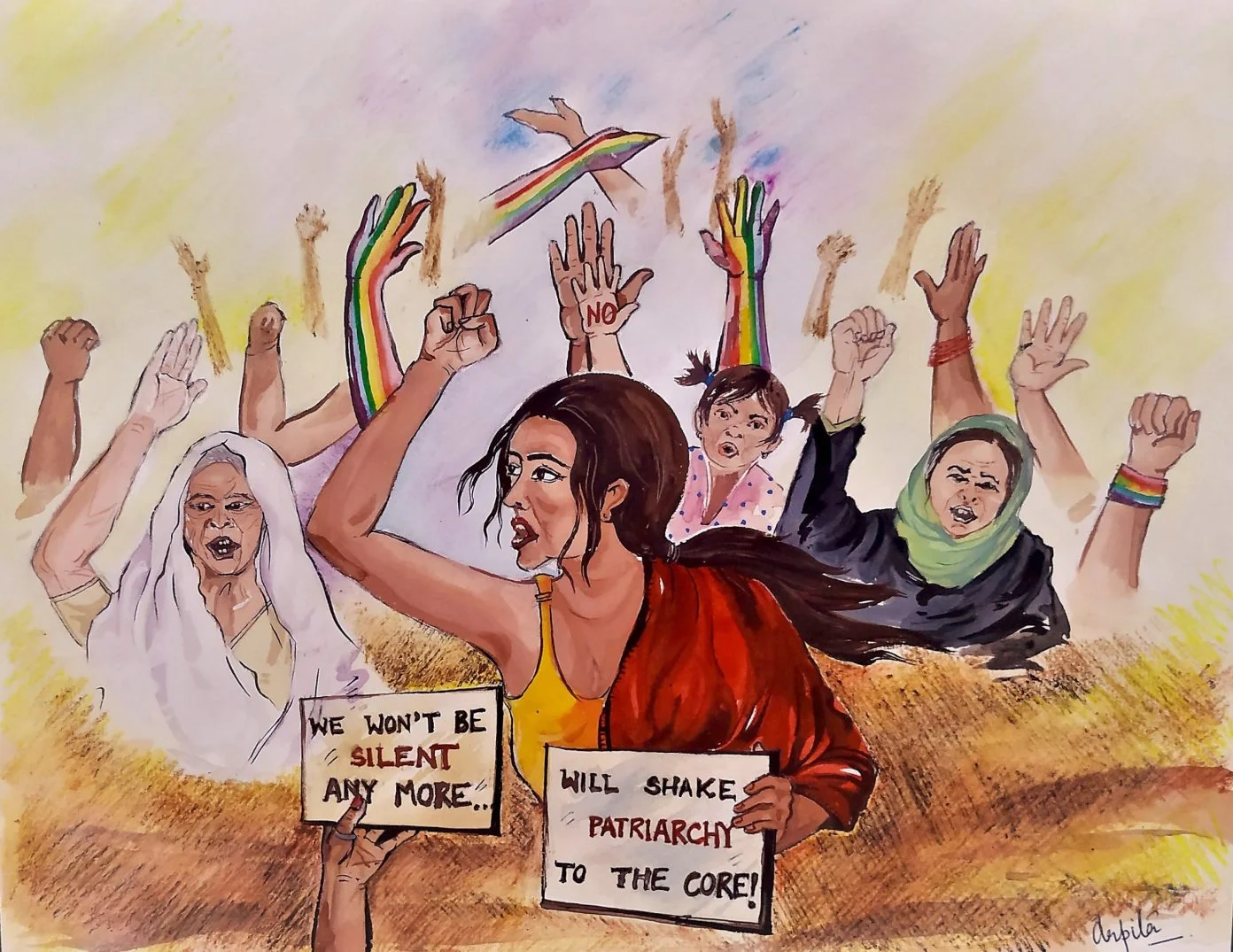
In women-authored versions of the Ramayana, Ram emerges as a man of weak character — described by women as a brute and a sinner. But this article is not only about Ram. It is about the civilization that produced him — and the state that is reproducing that civilization today.
Introduction
The RSS and BJP government’s present blueprint for a Hindu nation does not spring from nowhere — its roots run all the way back to ancient Aryan civilization. Just as Hitler in Germany promoted Aryan supremacy and made the establishment of Aryanism the cornerstone of his totalitarianism, the RSS’s Brahminism and its framework for a Hindu state has been patronizing that very same Aryanism for decades. This is not coincidence. It is continuity.
What is worth tracing carefully, then, is not merely the political surface of this continuity but its deepest structural layer — the organization of power over women’s bodies. The exercise of power over women was a familiar social structure even before Brahminism institutionalized the caste system. To understand what is happening in India today, we must begin not in 2014, not in 1992, not even in 1947 — but much further back, in the moment when the matriarchal egalitarian world was first dismantled and women were first converted into property.
The Position of Women in the Age of the Aryans
From approximately the pre-Vedic period, the Indian subcontinent came under the dominance of the Aryan peoples. The Aryans were primarily pastoralists; one school of thought holds that they seized the land of India’s ancient non-Aryan communities through armed conquest. This history has been documented repeatedly in Rahul Sankrityayan’s Volga to Ganga — a foundational text that traces human civilization from the Volga river to the Indian subcontinent, following the journey of Aryan peoples and the social transformations they imposed — and in Sukumari Bhattacharya’s Ancient India, a rigorous scholarly examination of Aryan life, society, and religious practice that reveals with precision what women’s social position actually looked like in that era.
Volga to Ganga traces how the egalitarianism of a matriarchal social structure was transferred into a patriarchal one, and how gender discrimination became institutionally entrenched. This collapse of the matriarchal egalitarian order was not a sudden event but a structural transformation — one that Friedrich Engels had already diagnosed with remarkable clarity in his 1884 work The Origin of the Family, Private Property, and the State.
Engels argued that in the earliest human communities, society was organized along matrilineal, communal lines. Women in these clans wielded genuine social authority — kinship was traced through the mother, and communal living meant women could act collectively against uncooperative men. The rise of private property broke this order. When men in former matriarchal tribes began claiming livestock as their own rather than holding it in common with the tribe, the question of inheritance became urgent. To ensure that a man’s wealth passed to his children and no one else’s, he needed absolute control over the woman’s sexuality. Monogamy thus arose not from love or morality but from the concentration of wealth in the hands of one person — a man — and the need to pass that wealth to his children.
The consequence was catastrophic for women. Engels called it plainly: “The overthrow of mother right was the world historic defeat of the female sex. The man took command in the home also; the woman was degraded and reduced to servitude; she became the slave of his lust and a mere instrument for the production of children.”
This is not metaphor. It is the material description of what occurred when land, territory, family, and authority were reorganized around male inheritance. The agricultural shift — the very moment celebrated as civilization’s progress — was simultaneously the moment that women were converted from social equals into property. Engels further argued that the first class antagonism in history coincides with the development of antagonism between man and woman in monogamous marriage, and the first class oppression with that of the female sex by the male. The oppression of women and class exploitation were not separate phenomena. They were two faces of the same historical origin: private property.
This is precisely what Volga to Ganga dramatizes in the Indian context, and what Sukumari Bhattacharya documents in the Rigvedic evidence. The Aryan pastoral economy — with its emphasis on cattle ownership and male inheritance — was the local expression of exactly this global transformation Engels identified. Bhattacharya writes that Aryan society was fundamentally pastoral and patriarchal. In the Rigvedic age, women’s roles were confined entirely to childbearing, tending livestock, serving in their husband’s household, and performing cottage industries. Beyond this, women had no role in sacrificial rituals or other religious rites. The matriarchal socialist structure did not die peacefully. It was dismantled, piece by piece, as land, livestock, and lineage became instruments of male power.
The Manuist tradition that is today invoked in discussions of patriarchal aggression is in fact far older than Manu — it is the social system built by the Aryans. Patriarchal social structure was never found among India’s indigenous peoples. Traces of egalitarianism and matriarchal customs survive among tribal communities even today — across parts of the Himalayas and its foothills, in Ladakh, Jammu, certain villages in Himachal Pradesh. Many scholars also believe that Bengal was once governed by a primal matriarchal system. The worship of Shakti has been present in Bengal and ancient Tibet from the earliest times, while the Aryans primarily venerated male deities with women represented only minimally. Yet in Volga to Ganga, Sankrityayan shows how, over time, men among the Aryans systematically curtailed women’s freedom — in battle, in public life, and ultimately in the most intimate dimensions of their existence.
What History Tells Us
To understand contemporary fascist aggression, one must know its origins. No position is ever accidental — behind every stance and every event lies the history of its formation, the ground in which its seeds were sown. Without going back to that foundation, no problem can ever be resolved at the root.
Whether we speak of caste hierarchy, class division, or the practice of gender discrimination — I use the word “practice” deliberately, because age after age, the powerful have shaped society into particular structures to serve their own convenience and consolidate their own power. They have enforced certain social, institutional, and religious norms over centuries, sometimes through the manipulation of subordinate classes — and in this way, those norms have become the bedrock of society. What the original social structure actually was is difficult to retrieve. Yet it has been observed that egalitarian, communal social organization was humanity’s oldest social system, which a small minority then progressively distorted through the establishment of various regulations and codes, all for their own benefit.
The question is not whether this history is recoverable in every detail. The question is whether we are willing to see the present for what it is: not a rupture from the past but its continuation.
The Connection Between Women and Land
Our purpose is to excavate and examine, from its ancient origins to the present, the history of Aryanist Brahminism. Hegel’s Phenomenology has been something of an inspiration in tracing the continuity between that history and today. Just as land acquisition is not a contemporary phenomenon — its seeds were planted in the Aryans’ establishment of dominance over this land — so too, patriarchy is not a present-day problem. Its seeds were sown in the earliest times.
Many historians believe that equality prevailed in Harappan and Mohenjodaro society, though evidence of class divisions is visible even then in urban planning. Khitimohon Sen’s Women of Ancient India gives us evidence of the gradual decline of women’s status from the Vedic period onward. There was once equal right over property for women and men in Indian society. Later, this was transformed so that women themselves became the equivalent of land — property to be protected and controlled by men.
In 1962, Noor Alam examined the question of women’s rights and their foundational position in Indian society. He showed that women’s sexuality has, from the earliest times in this country, been treated as equivalent to land or territory. Just as ownership of land remained in male hands, so too did control over women’s bodies remain tightly gripped by men. Men understood that without claiming sovereignty over women’s sexuality, no power over women could be maintained. That ancient convention persists, covertly, to this day. Sometimes the state — sometimes the family acting as a proxy state — tells women that their sexuality is reserved for their husbands alone.
In the Vedic age, if an upper-caste woman married a lower-caste man of her own choosing, the social punishment was severe: if a child was born of such a union, both mother and child were drowned in a river. The obsession with female “purity” connects directly to this same axis of sexuality. Brahmins instituted child marriage precisely to preserve caste purity. The politics of linking that purity to the purity of land and soil is not new. It was a carefully calculated move by Brahmins to bind women to the land — to nature itself — solely to maintain absolute dominion over women’s sexuality.
Women’s Position in Ancient Literature: The Ramayana
The condition of women is also captured within this country’s epic literature. Epics like the Ramayana and the Mahabharata are not simply religious texts — they are foundational documents for assessing what women’s social position actually looked like in their time, and more importantly, how the powerful wanted that position to be remembered and reproduced across generations.
In her essay Women Rewriting the Mahabharata, Nabaneeta Dev Sen examines Chandravati’s Ramayana through a female lens, and what emerges is a succession of patriarchal customs laid bare. Abduction and forced marriage was, for instance, a perfectly ordinary occurrence in this period. Women’s consent, women’s desire — these simply had no place. Dev Sen also brings out the dimension of women’s exile and darkened lives: Aryan men abandoned their wives, and that abandonment pushed women into a life of isolation and suffering.
She returns again and again to the argument that in Brahminical and Aryanist society, women had no freedom over their own sexuality whatsoever. To serve male desire, to fulfill male will — that was the sole identity assigned to women in that era. If a woman was abducted by another powerful man, it was she who was punished. The logic was consistent and merciless: the woman’s body is property, and damaged property is the woman’s shame, not the aggressor’s crime.
Dev Sen observes that when women write the Ramayana, the oppression visited upon them comes to the surface with force. In women-authored Ramayanas, Ram becomes a man of weak and contemptible character — women describe him as a brute and a sinner. Sita, on the other hand, is built up as a woman of strength. Even here Sita remains a victim of violence, yet she has the courage to speak publicly about the injustice done to her, to demand justice. There is a saying in Indian folk tradition: whatever language women speak, it is the language of loneliness, the language of sorrow and suffering. The women-authored Ramayana refuses that loneliness by making the suffering visible and the injustice nameable.
The model of the husband-wife relationship that Brahminical social structure has bequeathed to us is visible right there in the Ramayana. A husband puts his wife on trial for chastity, yet the man is required to prove nothing — no test of his own honesty or fidelity. That “tradition” continues in the Hindu-nationalist state we are marching toward. On one occasion, a Supreme Court acquitted a man who had raped his underage wife repeatedly over many days — the Court used marriage and childbirth as proof of innocence, and astonishingly, the burden of proving rape fell on the girl herself. Is this not identical in structure to Sita’s trial by fire? The epic and the courtroom share the same grammar. Only the costume has changed.
The Volga to Ganga Episode
In Volga to Ganga it is shown that during wars between two clans, the victorious clan plundered the defeated clan’s women along with all their property — land, livestock, weapons, grain. Women were equivalent to land, crop, and property — symbols of wealth to be seized and redistributed among the victorious. In many Sanskrit texts, women are described as Shri — a word that primarily denotes wealth and prosperity. The equation was not metaphorical. It was juridical.
The caste system, that product of Brahminism, impacted women’s lives far more devastatingly than it impacted even lower-caste men. One rule of the caste system (Pratiloma) stipulated that if a lower-caste man and an upper-caste woman had a child, the woman and child were to be drowned. The Jalpatra custom similarly represented the exploitation of lower-caste women by upper-caste men: a wealthy upper-caste man was permitted to keep a Dalit woman as a concubine, to sexually exploit her at will, and any child born of this arrangement had no recognized paternity. At the very moment that lower-caste people were declared untouchable, the upper classes felt no hesitation in physically exploiting women from those same communities. The body of the Dalit woman was simultaneously polluted and available — untouchable in public, accessible in private. This contradiction was not a failure of the system. It was the system’s design.
Property-Driven Oppression: Sati
In the early period of Indian social structure, there is no evidence of the practice of Sati — a widow immolating herself on her husband’s funeral pyre. Khitimohon Sen’s writings reveal that the practice was introduced not as tradition but as a mechanism of power: to ensure that the dominance of men in the transfer of property remained unchallenged. Before this, when a husband died, it was accepted practice in Aryan society that the living woman would remarry and bear children. Similarly, child marriage had no place in early Aryan society; it was introduced later by those in power specifically to maintain caste purity. The custom of women choosing their own husbands was likewise distorted, for the same reason.
Every practice that is today defended as ancient Hindu tradition — Sati, child marriage, enforced widowhood, the prohibition on widow remarriage — was in fact an invention, a deliberate institutional mechanism introduced at a specific historical moment to serve a specific material interest: the uninterrupted transmission of property through the male line. Tradition was always the mask that power wore when it wanted to avoid being recognized as power.
Oppression of Brahmin Women
Alongside Dalit women, Brahmin women too suffered the full brutality of patriarchy — a fact that is often obscured by the tendency to treat caste oppression and gender oppression as separate systems. They are not separate. They are the same system operating at different registers of the social hierarchy.
Around the practice of Kulin polygamy — where Brahmin men married multiple times — many women were murdered for property, and many more were dispossessed and abandoned. The practice of enforced widowhood — suppressing women’s sexuality and expelling them from all social rights and roles — has its origins, again, in the question of property ownership. In many instances, widows were not only exploited socially; they were physically exploited within the very households that confined them. The household, in Brahminical patriarchy, was never a place of safety for women. It was the primary site of their containment.
Women Under RSS and BJP Rule
In contemporary society, Ambedkar’s legislation and feminist legal provisions may be inscribed in the Indian Constitution, but the reality on the ground remains the same. The present government has sent its message in many forms: women’s primary purpose is to be protected like property, to serve their families and husbands, and to bear children for the nation. Golwalkar himself wrote that the role of the traditional Indian woman is to serve her husband, his family, and to produce children. This is not the private opinion of one man. It is the organizational ideology of the RSS — and it is the ideology that presently governs India.
The Bilkis Bano case is perhaps the most chilling institutional endorsement of this violence. During the 2002 Gujarat riots, Bilkis Bano — a Muslim woman, five months pregnant — was gang-raped, and fourteen members of her family were massacred. After years of relentless legal struggle, eleven convicts were sentenced to life imprisonment. But in August 2022, the BJP government at the Centre facilitated their early release under a remission policy — and what followed was not quiet rehabilitation but open celebration. The released convicts were garlanded and welcomed as heroes by BJP-affiliated groups in Gujarat. The state did not merely fail to protect a woman who had been gang-raped; it actively honored the men who did it. This is not a lapse in the system — it is the system, operating exactly as the ideological architecture of Brahminical patriarchy always intended: the woman bears the wound, the man walks free wearing flowers.
In 2023 in Karnataka, a nurse was dragged away and sexually assaulted, after which an upper-caste doctor hurled caste-based slurs at the woman. Twenty-one police officers who raped eleven tribal women in a forest were acquitted without consequence. In Rajasthan, a tribal woman was raped and then burned alive. The pattern is not regional. It is national. It is structural. And it has a very long history.
Conclusion: The Abject Body — Kristeva, the Witch, and the Living Wound
To understand why this violence is not merely political but psychic — not merely historical but structural — we must turn to the French philosopher and psychoanalyst Julia Kristeva, and her landmark 1980 work Powers of Horror: An Essay on Abjection.
Kristeva’s concept of abjection describes the process by which a social order maintains its identity by violently expelling whatever threatens its coherence. The abject is not simply the enemy or the outsider — it is that which disturbs identity, system, and order from within. It does not respect borders, positions, or rules. And the body that patriarchal civilization has most consistently cast as abject — across cultures, across centuries — is the female body. The woman’s body, in this psychic architecture, represents everything the patriarchal ego must dominate and contain to sustain its own fantasy of purity, territory, and control.
To make this concrete: consider how the Brahminical obsession with ritual purity — the elaborate codes around menstruation, childbirth, widowhood, caste mixing — maps precisely onto Kristeva’s framework. The menstruating woman, the widow, the Dalit woman who crosses a caste boundary — each of these figures is treated as a source of contamination, disorder, a threat to the purity of the social body. She must be expelled, contained, punished, or erased. This is abjection operating as social policy. It is not incidental to Brahminical order. It is the mechanism through which that order reproduces itself.
This abjection finds its most savage expression in the theater of war. Women and children are historically the first targets not because they are tactically significant, but because the destruction of the female body is the most legible message of conquest one patriarchal power can send to another. Genocide rape — as a deliberate instrument of war — is not a byproduct of conflict. It is the logic of it. We have seen this with shattering clarity in Palestine, where the systematic targeting of women’s bodies, the destruction of maternity hospitals, the mass killing of mothers and children, is not military necessity but a statement of territorial abjection — the conquered land and the conquered woman rendered identical, both to be emptied and controlled. This is not a new grammar. It is the same grammar Engels identified when Aryan conquering tribes looted women alongside cattle and grain. The body and the land remain, across millennia, the same site of inscription for male power.
In India, this abjection carries an additional layer of historical violence specific to the fate of the mother goddess tradition. Mother goddess worship — Shakti, the feminine divine as supreme creative principle — was not a marginal or subordinate tradition. It was the indigenous spiritual bedrock of vast swathes of the subcontinent, particularly in Bengal, the Dravidian south, and tribal communities across the country. This tradition encoded a fundamentally different relationship between society and the female principle — one in which the feminine was not abject but sacred, not a source of pollution but of power. British colonialism, in its anxiety to classify and control Indian religion through a Brahminical upper-caste lens, systematically delegitimized these goddess-worshipping, matrilineal, and often lower-caste traditions. The colonial anthropological gaze — itself a patriarchal and racist instrument — recorded Brahminical textual religion as “real” Hinduism and everything else as primitive superstition. Brahmin cultural hegemony, which had already been working to subordinate these traditions for centuries, found in British colonialism a powerful amplifier. The abject was now not merely the woman but the indigenous woman’s spirituality — doubly expelled, doubly erased.
This same logic of abjection produced the witch hunt. In Europe, between the 15th and 18th centuries, women who held knowledge, who healed, who lived outside male domestic structures, who owned land, who were simply inconvenient — were systematically identified as abject threats to the Christian patriarchal order, tried, tortured, and burned. The Malleus Maleficarum (1486), the theological rulebook of the witch hunt, is essentially a manual of abjection: it catalogues in obsessive detail the dangers of the female body, female sexuality, and female autonomy. What is being destroyed is not witchcraft. What is being destroyed is the last remnant of female social power that predates the fully patriarchal order.
This is not a closed chapter of European history. It is a living, breathing condition in India today. In Bihar — and across Jharkhand, Chhattisgarh, and other states — women, overwhelmingly Dalit and Adivasi, are regularly branded as witches, stripped, paraded, tortured, and murdered. The accusation of dayan — witch — is most frequently deployed against women who own property, who refuse sexual advances from powerful men, or who are simply inconvenient to dominant-caste interests. The structure is identical to the European witch trial: the female body as abject threat to social order, the community as instrument of its destruction, and the state as indifferent or complicit witness. The witch trial did not end. It migrated. It changed its language. But in Bihar today it wears the same face it wore in 15th century Europe — the face of a social order that cannot tolerate a woman who refuses to be expelled.
What Kristeva gives us, then, is not merely a psychoanalytic framework but a mirror held up to the entire history this article has traced. From Vedic ritual pollution codes, to the Brahminical conversion of women into land-equivalent property, to the dayan murders of Bihar, to Bilkis Bano’s garlanded rapists — the same psychic structure persists across every transformation of the social surface: the female body as that which must be expelled, controlled, or destroyed so that the patriarchal order can narrate itself as pure, sovereign, and legitimate.
Whose Nation Is This?
The RSS’s political ideology has always been inseparable from Brahminism — and Brahminism has always been inseparable from the most crude and systematic patriarchy. Golwalkar’s own writings make no pretense otherwise: women belong in the home, in the kitchen, and in the service of reproduction. The woman, in this worldview, is not a human subject with interiority, desire, or political existence. She is a vessel. A demographic instrument. A body whose primary function is to produce children for the nation — which is to say, for the Hindu Brahminical order.
This is not incidental to the RSS project. It is foundational to it. When we witnessed the demolition of Babri Masjid, the slogans that rang out were not only communal — they were simultaneously casteist. ST, SC murdabad. The annihilation of the mosque and the annihilation of Dalit and Adivasi dignity were spoken in the same breath, by the same mouths, driven by the same logic. Brahminical crude patriarchy and Brahminical casteism are not two separate pathologies. They are one integrated structure of domination — and the BJP-RSS axis is its present political form.
The data confirms this with brutal consistency. Uttar Pradesh, Bihar, and Gujarat — states where BJP governance is most deeply entrenched and most ideologically saturated — rank among the most dangerous states in India for women. The Labour Codes consolidated under this government carry within them the same patriarchal logic: women’s labor systematically undervalued, women’s wages structurally unequal, women’s bodies available for economic exploitation just as they have always been available for sexual and domestic exploitation. The Shrama Code is not merely bad labor policy. It is patriarchy institutionalized in the language of economic management — the ancient equation of woman and property, now dressed in the administrative language of the modern state.
This, then, is the moment to pause. To revisit. To think with the full weight of this history pressing down on the present. What does this government actually want to do with India? What is the destination of this road paved with demolished mosques, garlanded rapists, burning Adivasi women, and rewritten textbooks? Indian democracy — the constitutional vision of Ambedkar, the plural, secular, egalitarian republic wrested from centuries of hierarchical violence — has been progressively hollowed out, its institutions bent toward majoritarian Brahminical will.
The BJP and RSS speak of Akhand Bharat — One Nation, undivided, eternal, supreme. But we must ask the question they do not want asked: whose nation? One nation for whom? This land — this ancient, plural, multilingual, multi-religious, matrilineal-in-its-bones land — belongs to whom?
It does not belong to those who garland rapists. It does not belong to those who burn Dalit women as witches. It does not belong to those who erase the mother goddess, rewrite the epics, and demolish the evidence of every civilization that preceded their own claim to sovereignty.
Source references: Friedrich Engels, The Origin of the Family, Private Property, and the State (1884); Julia Kristeva, Powers of Horror: An Essay on Abjection (1980); Rahul Sankrityayan, Volga to Ganga; Sukumari Bhattacharya, Ancient India; Khitimohon Sen, Women of Ancient India; Nabaneeta Dev Sen, Women Rewriting the Mahabharata; M.S. Golwalkar, Bunch of Thoughts; Malleus Maleficarum (1486).
( The author is a gender activist, psychoanalysis scholar, and editorial assistant)
