
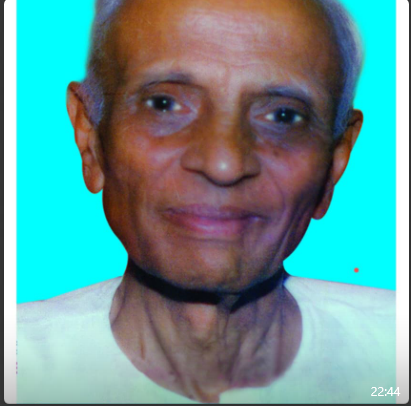
Class, Caste Marxist Theorist – Kolla Venkayya!
(27th Death Anniversary of Kolla Venkayya – September 17, 2025)
Kolla Venkayya was a freedom fighter of distinction and a unique personality in theory, politics, and practice at the national level of the Indian Communist movement.
He was born in 1910 in Pedanandipadu, the center of the tax-resistance movement, into a wealthy landlord family as the eldest son among six children of Kolla Krishnayya and Rattamma. He completed his primary education in Pedanandipadu, high school in Bapatla, and his Intermediate and B.A. at Andhra Christian College, Guntur. Under Baba Apte, he became a Hindi scholar and received the Visharada degree and an honor shawl from Mahatma Gandhi at the South India Hindi Mahasabha in Madras. He participated in the national movement against British imperialism and was imprisoned. In 1928, when Gandhi visited Pedanandipadu, Venkayya played a key role in organizing the event alongside village elders like Lavu Ankamamma, Parvataneni Veeraiah, and Govindulu.
After August 15, 1947, when the national government was formed, he stood at the forefront of the struggles against landlordism and capitalism under communist leadership. Though he began his political life under Gandhi’s peaceful leadership, even as a student in 1931 he campaigned against untouchability and caste discrimination across Bapatla taluk. He attended the 1934 Bombay Congress as a delegate. Initially a Congressman, his life turned towards communism in 1936 while at A.C. College, Guntur, influenced by Pole Peddi Narasimhamurthy, Pulupula Venkata Sivaiah, Makineni Basava Punnayya, and Nanduri Prasad Rao. From then until his death, he never turned back from the struggles for the liberation of the oppressed.
When ITC and other tobacco companies exploited peasants, he mobilized farmers in Guntur and Krishna districts, and as a result, was elected chairman of the Guntur District Tobacco Growers Association (1944–48). During the Telangana armed struggle, the central communist leadership appointed Venkayya as convener, along with Madala Narayanaswamy and Pedavali Sriramulu, to lead anti-landlord struggles in the plains. Over 200 youth joined these struggles under their leadership. He was elected twice to the Central Control Commission of the united Communist Party and held many posts: district secretary, state executive member, state secretariat member, and state peasant front secretary.
He was elected to the Madras Legislative Assembly in 1952 (Ponnur constituency), to the Andhra Pradesh Legislative Council in 1957, and to the Lok Sabha in 1962 from Tenali, defeating Acharya N.G. Ranga. He became the first MP to resign (1967) from Parliament on the demand that Visakha steel belongs to Andhra. As splits shook the communist movement, he moved from CPI to CPI(M), and later, with T. Nagi Reddy, D.V. Rao, and Chandra Pulla Reddy, towards the Marxist-Leninist movement. He opposed CPI(M) in the Palakollu Plenum (Andhra) and Bardhaman Plenum (West Bengal). He lived underground (1948–51), faced trial in the Parvathipuram Conspiracy Case (1968), and spent over 10 years in jail, including during the 1975 Emergency. He donated his share of 4.5 acres of land, the proceeds from selling it, and his MP pension to the party.
In over 70 years of political life, he stood out as a spotless leader of peasants, the rural poor, and the oppressed, advocating “land to the tiller,” civil rights, and Marxist-Leninist revolutionary theory. He passed away on September 17, 1998. Kolla Venkayya was a national treasure, deeply studied in Marxism-Leninism-Mao thought. His simplicity, integrity, theoretical rigor, ceaseless study, social analysis, and dedication to the oppressed remain an ideal for future generations.
After the Karamchedu Dalit massacre, debates arose within and outside the communist movement on caste in Indian society. Critics argue communists prioritized class analysis and economic struggle while failing to address caste as a structural question. Though communists made immense sacrifices for land struggles of Dalits and Adivasis (Telangana armed struggle, Srikakulam tribal struggles, Godavari valley resistance, Kondamodu, Rompicherla, Indravelli uprisings, etc.), a systematic annihilation of caste was not pursued. But Venkayya had a unique perspective—unlike many others, he emphasized caste in his writings and speeches as early as 60 years ago.
In the 1955 Andhra State Communist Party conference at Revendrapadu, he presented a “note” analyzing landlord caste domination. He argued:
“Landlords are inherently casteist; they exploit backward castes’ weakness for village dominance. Caste has been a foundation stone of feudalism in India. Ignoring caste is a mistake. Majority-caste landlords use caste unity for dominance, while minority/backward castes rally to us as allies. Feudalism in India is deeply entangled with caste; without analyzing caste, we cannot understand which side rich peasants, bourgeois intellectuals, or political actors stand on.” (Collected Works of Kolla Venkayya, Vol. I, pp. 39–40).
He also noted that upper-caste landlords use caste unity for dominance, while weaker castes use it for survival. He saw caste as a special form of division of labor, similar to Marx’s writings on India and Egypt (1848). He criticized early communist errors, e.g., dismissing Dalit tenants’ self-organizing in Maharashtra (1924) as “caste movements.” He insisted that rejecting caste struggles as “divisive” was a grave mistake.
He further cited Engels (1890) clarifying that while economic production/reproduction is ultimately decisive, Marx and Engels never claimed it was the only factor. Social and caste structures also shape history. Venkayya repeatedly emphasized that social and economic struggles must proceed in coordination, not competition.
He was a tireless agitator on people’s issues—leader of the Nallamada anti-submergence movement, founder of the Rural Poor Association in Guntur-Prakasam, and a fighter who went up to the Supreme Court for implementation of 1973 land reforms. His writings include: Indian Languages-Nations-Democratic Solution, Our Basic Theory, Evolution of Indian Society, Caste System: Origins and Development, and Need for Reconsideration in the Communist Movement.
Comrade Kolla Venkayya, a martyr in public service, stands as a model of philosophical depth and pure patriotism for today’s generations.
Revolutionary Salutations,
Mannava Hariprasad,
Politburo Member, CPI(ML) Red Star
📞 82 47 72 82 96
📧 mannavahariprasad@gmail.com
