
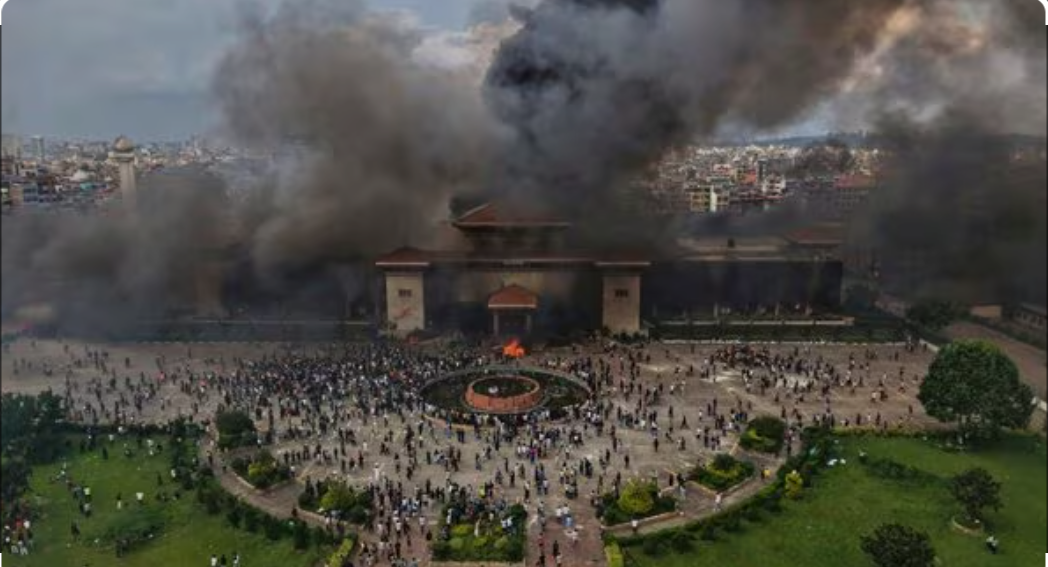
The “Gen Z” protests led by students in Nepal that began on 7 September as a campaign in response to the government ban on Social Media had transformed into a violent flare-up within two days. In the context of people’s sharpening criticism against the Sharma Oli regime’s corruption, nepotism and repression, coupled with the shameless approach of other political parties to them, the campaign against the Social Media ban suddenly escalated into unprecedented violence, leading to the resignation of the Oli government itself. Even after the lifting of the ban on Social Media by the evening of 8 September, the protestors stormed many government buildings, followed by setting the parliament and official residences ablaze, which even extended to the houses of high-profile Nepali leaders, irrespective of their political orientation and affiliation.
In spite of the belated intervention of the Nepal Army and it’s taking charge of security operations, imposition of country-wide restrictive orders, followed by declaration of curfew, Army personnel patrolling the streets, joint appeal by the army, police, and top bureaucrats urging peaceful political talks, etc., the situation is volatile, and uncertainty prevails regarding country’s future leadership. As per the latest information, Nepal President Paudel is scheduled to meet “Gen Z” protestors along with Nepalese Army, for a peaceful resolution of the political issue through dialogue.
Meanwhile, not only the ruling class parties, but even the so-called mainstream Left, including erstwhile Maoists, have become neoliberal, depoliticised, corrupt and disoriented. While the present struggle is mainly led by students and urban youth, the broad masses of working and rural people are not seriously involved in these streams. According to available information, while the “Gen Z” protestors’ struggle against corruption and political apathy of the rulers are laudable, they have not yet put forward any alternative to far-right neoliberal policies.
As the situation is still fluid, reports on emerging alternatives are not augur well for the future. For instance, one prominent figure among them is Rabi Lamichhane of Rastriya Swatantra Party (RSP), whose pro-monarchy and pro-Indian orientation is self-evident. His party’s resignation with 21 MPs itself was a strategic move to create political disruption. Now, Lamichhane is tapping into widespread frustration among young Nepalis, students, and urban professionals. Even though, Kathmandu Mayor Balendra, a staunch supporter of “Gen Z”, and vocal against corruption and nepotism, he also upholds neoliberalism which is the source of corruption today. According to reports, Baburam Bhattarai, former Prime Minister, has entered discussions around possible interim arrangements. Janamat Party Nepal, Nagarik Unmukti Party, and some independents are also in the fray.
However, the various forces mentioned above, who are capitalizing on the widespread discontent among Nepal’s younger generation, have not yet put forward a viable political alternative to the crisis confronting Nepal today. As such, as has been the case with other South Asian countries, though people are rising up against the ruling system, in the absence of a people’s political alternative, in Nepal too, global neoliberal-neofascist centres are likely to take advatage of the situation in coordination with domestic reactionary and pro-monarchy forces. The repeating political turmoils in Nepal once again brings to the fore the urgent need of a Left-Democratic alternative to the unholy nexus between domestic reactionary ruling classes on the one hand, and external forces of neoliberal corporatism, on the other.
International Department
CPI (ML) Red Star
New Delhi
10.09.2025
