
PRESS RELEASE
The Morcha asks: Will the imposition of UCC in Chhattisgarh ensure equal education, equal healthcare and equal employment opportunities for all?
Raipur | 11 November 2026
Jan Sangharsh Morcha Chhattisgarh has strongly condemned the BJP government’s move to impose the Uniform Civil Code (UCC) in Chhattisgarh, following the pattern of Uttarakhand, Assam, Madhya Pradesh and Uttar Pradesh. The Morcha has described this initiative as grossly unconstitutional and anti-people, and as particularly hostile to minorities, especially Muslims, Adivasis, women, LGBTQ+ communities and other marginalised sections of society. It has demanded the immediate withdrawal of this initiative.
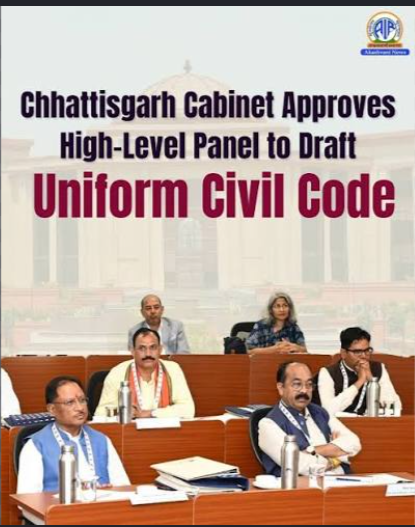
In this connection, a letter has been submitted to the five-member committee constituted by the Chhattisgarh government in June 2026 to prepare a draft Uniform Civil Code for the state, following the Cabinet decision of 15 April 2026.
In a statement, Jan Sangharsh Morcha Chhattisgarh said that it vehemently opposes the manner in which UCC Bills have been passed in BJP-ruled states such as Uttarakhand, Gujarat and Assam, all governed by the BJP’s so-called ‘double-engine’ governments. Union Home Minister Amit Shah has also declared in Uttar Pradesh that the BJP will form the government for a third consecutive term in 2027 and implement the UCC there.
The BJP has projected the UCC in every state as a measure to promote gender equality, social reform and development. However, both the processes through which these laws have been introduced and their actual provisions appear to move in precisely the opposite direction.
We consider these laws fundamentally opposed to the Constitution of India and thoroughly anti-people. Moreover, the BJP’s desperation to introduce the UCC under the ideological guidance of a fascist organisation like the Rashtriya Swayamsevak Sangh (RSS) exposes its fundamentally anti-Muslim, anti-Adivasi and anti-minority character. It also reveals its hostility towards people entering inter-caste and inter-religious marriages, those living in consensual live-in relationships, and marginalised communities such as LGBTQ+ people.
The UCC has been drafted without the participation of the very people who will be subjected to it. Instead of delivering the promised equality, these laws impose additional burdens, surveillance and risks on citizens, particularly women, minorities and marginalised communities.
In our assessment, these laws directly and indirectly violate the fundamental rights guaranteed by the Constitution of India, particularly the rights to life, personal liberty, privacy and freedom of religious practice.
Directly, compulsory registration, scrutiny of private relationships, sharing personal information with the police and penalties for non-registration restrict the right to personal liberty, privacy and the freedom to choose one’s life partner, protected under Article 21. They also have unequal and disproportionate consequences for different sections of society, raising serious concerns under Article 14.
Indirectly, these laws replace the personal laws and customary practices through which different communities regulate marriage, divorce and inheritance with a single state-controlled system. At the same time, they assign religious leaders and community heads a role in the verification process. This affects the freedom of religion guaranteed under Article 25, the right of religious denominations to manage their own affairs under Article 26, and the right of communities to conserve their distinct culture under Article 29.
The exclusion of Scheduled Tribes from the UCC in Uttarakhand and Assam itself acknowledges the constitutional significance of customary practices and religious observances. The same constitutional consideration must be extended to other communities as well.
The undemocratic process behind the UCC
In Assam, the Bill was introduced on Monday and passed by Wednesday of the same week. The Speaker rejected the Opposition’s demand that it be referred to a Select Committee for detailed examination.
In Gujarat, no complete draft was ever placed before the public. The Bill was directly introduced in the Legislative Assembly and passed.
In Uttarakhand, the Code was passed within a few days of its introduction. Its implementing rules had to be amended four times in less than ten months.
Reforms concerning personal laws, introduced through such undemocratic and hurried processes, cannot legitimately claim public consent or democratic participation.
Gender inequality and discrimination under the UCC
Both the Uttarakhand rules and the Assam Bill prescribe different minimum marriage ages for men and women: 21 years for men and 18 years for women.
The existing rights of wives in polygamous marriages are not clearly protected under the Uttarakhand framework. According to published analyses, the Uttarakhand Code abolishes the coparcenary system through which daughters had acquired birthright in ancestral property. Gujarat’s Bill, meanwhile, introduces no substantial measures towards advancing gender justice.
These Codes are therefore ‘uniform’ only in name.
Scheduled Tribes are excluded in Uttarakhand and Assam, while substantial customary exemptions continue to remain in place. Yet other communities are subjected to the full burden of registration requirements.
The Uttarakhand rules even retain provisions for registering existing polygamous marriages, including forms that accommodate up to four wives.
The bulk of the administrative machinery created by these laws is devoted to registration, fees, penalties and scrutiny of private relationships. Gujarat’s Bill, in essence, lays down bureaucratic procedures for registering marriages, divorces and live-in relationships.
What is conspicuously missing is any meaningful focus on measures that could actually improve women’s lives, such as access to family courts, legal aid and effective enforcement of maintenance rights.
1. Uttarakhand: Uniform Civil Code, 2024 and Rules, 2025
Registration of existing marriages and penalties
Marriages solemnised before the enactment of the Code were required to be registered within six months. Delayed registration attracts late fees, while intentional or negligent non-compliance may invite penalties prescribed through government notification.
Rejection of registration can leave spouses without legal proof of marriage
An existing marriage may be rejected for registration on grounds such as the absence of a recognised marriage ceremony, the spouses not having lived together since the marriage, or either party being in a live-in relationship.
Such rejection can leave the spouses without documentary proof of marriage for purposes of maintenance, inheritance and official records concerning their children.
Surveillance and police scrutiny of private relationships
Registrars are required to examine databases relating to existing marriages and live-in relationships and conduct discreet enquiries through their own sources. The rules do not clearly define the limits of these powers.
Declarations concerning live-in relationships are forwarded to the local police station. Under Section 32 of the Code, information about a possible offence must be communicated to the police.
Although a duty to maintain confidentiality was introduced through an amendment in November 2025, the rules do not specify any effective remedy in the event of a breach of privacy.
Where both partners fall within the category of prohibited relationships, a certificate from a religious leader or community head is required. Registrars may also seek verification from community heads.
This places couples who marry against the wishes of their families or communities, particularly inter-caste and inter-religious couples, at serious risk of harassment and interference.
Live-in relationships
Registration of live-in relationships is compulsory. Registration may be refused if either partner is already married or involved in another relationship.
Failure to comply with registration requirements may result in a notice, and deliberate non-compliance can lead to a complaint before a magistrate.
This is particularly disturbing because courts have already recognised the legality of consensual live-in relationships between adults.
Unprotected rights of wives and children in existing polygamous marriages
The rules do not clarify the rights of wives and children in existing polygamous marriages regarding maintenance, residence or inheritance.
Form 1 permits an individual to apply independently for registration only if they are divorced, widowed or their marriage has been annulled.
Consequently, a wife whose husband refuses to cooperate appears to have no independent route to register the marriage, even though the penalties are directed at those who fail to register.
Unequal marriageable age
Men below 21 years and women below 18 years are treated as being below the marriageable age.
Thus, a Code that claims to promote equality explicitly institutionalises gender-based differentiation in the minimum marriageable age.
Exclusion of same-sex and transgender partners
The prescribed forms refer exclusively to ‘husband and wife’ or ‘male and female’. Same-sex and transgender partnerships are consequently excluded from the framework.
A Code that is not uniform
Scheduled Tribes are excluded, making it clear that the Code does not apply uniformly to all residents.
Initially, Aadhaar numbers were mandatory in all registration forms. An amendment in November 2025 replaced this requirement with a broader list of acceptable identity documents.
This effectively acknowledges that insisting on a single identity document excludes people from accessing the registration system.
The fact that the framework underwent four amendments in less than ten months demonstrates that it was implemented before it was adequately prepared.
Inheritance rights
According to published analyses, the Code abolishes the distinction between coparcenary property and ancestral/self-acquired property.
This undermines the birthright of daughters in ancestral property recognised through the 2005 amendment to the Hindu Succession Act. It also opens the possibility of excluding daughters through wills.
2. Gujarat: Uniform Civil Code Bill
The draft was never placed before the public for consultation. Instead, the Bill was directly introduced and passed in the Legislative Assembly.
The Bill essentially reduces the UCC to a bureaucratic mechanism for registering marriages, divorces and live-in relationships. It substantially retains customary exemptions, while a significant portion of its text deals with inheritance.
The powers granted to Registrars to investigate violations of Section 4 are arbitrary and inadequately defined. These powers could be used against couples who marry or live together against the wishes of their families and communities, particularly inter-religious and inter-caste couples.
The retrospective application of stringent provisions places communities that solemnise marriages and regulate divorces through customary laws, and often possess limited documentary records, at serious risk.
Their existing marriages could be invalidated, while they may face harassment during the appeal process.
The scrutiny of live-in relationships by Registrars and the forwarding of personal details to the local police amount to an attempt to criminalise consensual live-in relationships and constitute a violation of the right to privacy.
The Bill also completely ignores transgender people and the wider LGBTQIA+ community.
3. Assam: Uniform Civil Code, Assam, 2026
The Bill was passed by a voice vote within the same week in which it was introduced. The Opposition had demanded extensive public consultation, but its demand to refer the Bill to a Select Committee was rejected.
The Bill prohibits polygamy and makes registration of live-in relationships compulsory. This raises the same serious concerns regarding privacy, surveillance and potential criminalisation that have emerged in the case of Uttarakhand.
It also prescribes different minimum marriage ages for men (21 years) and women (18 years), while excluding Scheduled Tribes from its ambit.
We are examining the original text of the Assam Bill clause by clause. The observations presented above are based on reports and published analyses of the Bill.
The real agenda behind the BJP-RSS’s UCC initiative
Like its initiatives in other BJP-ruled states, the move to introduce the Uniform Civil Code in Chhattisgarh is fundamentally driven by the Islamophobic ideology of the fascist RSS-BJP combine.
Islamophobia means deliberately creating fear, hatred and division by portraying Islam and Muslims as threats.
Under the pretext of uniformity, gender equality and social reform, the BJP-RSS is attempting to advance its divisive political agenda, undermine the constitutional rights of minorities and marginalised communities, and strengthen its authoritarian control over people’s private lives.
The Morcha therefore raises a fundamental question: If the BJP government is genuinely concerned about equality and social justice, why is it not ensuring equal access to education, healthcare, employment, social security and dignity for all? Why is it instead seeking to impose a UCC that threatens the constitutional rights and freedoms of vulnerable communities?
OUR DEMAND
Jan Sangharsh Morcha Chhattisgarh unequivocally rejects this grossly unconstitutional and anti-people initiative, which is particularly hostile to the Muslim community and other religious minorities, Adivasis, women, LGBTQ+ communities and other marginalised sections of society.
We demand that the RSS-BJP government’s move to impose the Uniform Civil Code in Chhattisgarh be immediately halted and withdrawn.
Down with the anti-people and divisive agenda of the RSS-BJP!
Defend the Constitution! Defend democratic rights and civil liberties!
Issued by:
Tuhin, Neera and Chouraram
On behalf of the Convening Committee
Jan Sangharsh Morcha Chhattisgarh
Contact: 9425560952, 7089356481, 7000229222
