
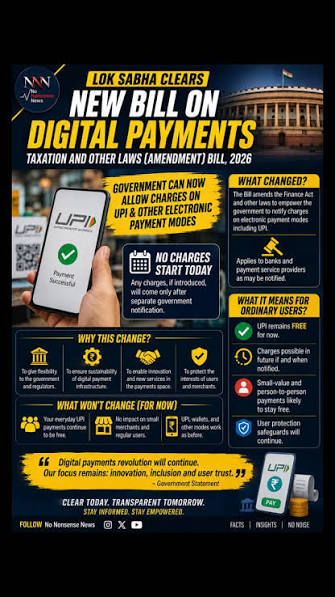
The Taxation and Other Laws (Amendment) Bill, 2026, passed by the Lok Sabha authorizes the government to go for a transaction levy/tax on Digital Payments. Though its details are yet to come out and, even as an immediate levy or tax on digital payments is not imminent, the legislation permits a Merchant Discount Rate (MDR) or service charge on digital payments like UPI (Unified Payments Interface) and RuPay in the days ahead. At the same time, according to Indian Finance Minister, the amendment will ensure the long-term financial sustainability of banking and payment infrastructure. It implies that this move on the part of the Modi government is driven by the domestic cost of running the infrastructure, and is intended for alleviating the domestic burden on banks and payment service providers.
However, this argument is not in conformity with the facts. As already noted by experts and well- meaning people, the RBI, which through the National Payments Corporation of India is regulating the UPI payments, has the financial capacity to easily manage the Digital Payments System without creating any burden for its stakeholders. For instance, during the last financial year alone, the RBI had transferred Rs 2.86 lakh crore of its surplus fund to the Central government, and a very small fraction of it is enough to maintain the entire UPI mechanism. As such, the real reason that prompted the Modi government to go for a transaction levy on digital payments is something else.
Here comes the staunch criticism raised by the United States Trade Representative (USTR) against India’s UPI and RuPay framework in its March 2026 National Trade Estimate Report that targeted India’s digital payment system for its exclusion of American giants like Visa and Mastercard from the Indian market. Revealingly, the USTR’s categorisation of India’s zero-MDR digital payment networks as foreign trade barriers against Visa and Mastercard also coincides with the ongoing US-India trade negotiations which are also biased against India. Of course, as far as the US imperialism is concerned, this is not an isolated move. Accusing Brazil’s free instant payment system, Pix, as providing preferential treatment for Brazilian stakeholders, the US even went to the extent of imposing tariffs on Brazil after Section 301 investigations. Therefore, the Modi regime’s move towards imposition of transaction levy on domestic digital payments is not prompted by national interests, but for creating level playing fields and competitive advantage for US digital and electronic companies operating in India.
In fact, when India launched the UPI in 2016, the US had established its firm roots in Indian financial markets through its debit and credit cards like Mastercard, Visa, etc. As such, treating the UPI as a localised experiment in India, its close ally and junior partner, the initial response of the US towards UPI was one of disregard with skepticism. However, the value of UPI transactions which was just ₹7000 core in the financial year 2016-17 rose to more than ₹314 lakh crore in 2025-26, becoming the world’s largest and broad-based real-time payment platform, driving out the US card intermediaries like Visa and Mastercard in the process. Now, as the Indian people have shifted to UPI transactions instead of US swipe cards, it’s the appalling loss of potential revenue to American companies and consequent US diktats that prompted the Modi regime to impose a new legislation for a transaction levy on digital payments, pushing the entire burden on common people, and paving the way for renewed entry of US companies into the Indian digital market.
No don’t, this move by Vishwaguru once again reveals how the country’s policy decisions are dictated by the US imperialist master and how the so-called ‘cultural nationalism’ acts as a cover for serving corporate capital at the expense of Indian people’s interests !
