
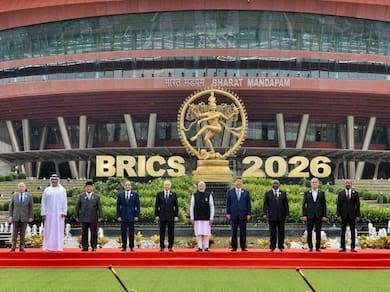
BRICS Summit Beats Around the Bush, Avoiding the Core Issues to be Addressed!
P J James
The 140-paragrah New Delhi Declaration that follows the two-day 18th BRICS Summit chaired by India, though depicts the “Global South” as the “driver for positive change”, it failed to address the core issues confronting humanity today in an objective manner. To put it differently, in tune with the competing and contradictory interests among its 11 members and 10 partner countries, now the Declaration that came out, while claims itself as a “consensus statement”, is cautious not to mention the names of countries who are behind the most threatening issue today, i.e., the aggression on Iran and global threats therefrom. Thus, references to “multipolarity”, “global governance”, “unity of Emerging markets and Developing Countries”, “climate finance”, “AI governance”, “digital health networks”, “peace and stability”, “nuclear disarmament and arms control”, “sustainable… supply chains of critical minerals”, “combating terrorism”, etc. , that are there in the Declaration, are functioning only as a cover for beating around the bush to avoid core questions.
For instance, regarding the unilateral US-Israel aggression on Iran, due to the so called “delicate diplomacy” arising mainly from Modi regime’s nexus with US and Israel, the BRICS Declaration fails to directly mention the US-Zionist axis, the perpetrators of this horrific crime on humanity, though it expresses “deep concern” over attacks on civilian infrastructure and nuclear facilities in West Asia. And, the biggest setback of the 18th BRICS Summit is its total silence on “De-dollarisation” and regarding the much discussed move towards a BRICS currency, which, if materialized, is not only a counterweight to Western imperialism but also a deathblow to the US role as the supreme arbiter of the postwar neocolonial global order. While China and Russia are working for an anti-dollar global monetary architecture, the Indian regime which is clinging on to the apron strings of the US, is against such a move.
Thus, as a manifestation of the inherent conflicting political-economic interests and geo-strategic alignments among its leading members, the BRICS is repeatedly failing to act as a strategic grouping capable of taking independent positions on the most crucial questions confronting the world today. To be precise, it still operates like an informal consultative forum or platform instead of an international organisation with a binding agreement or treaty.
