
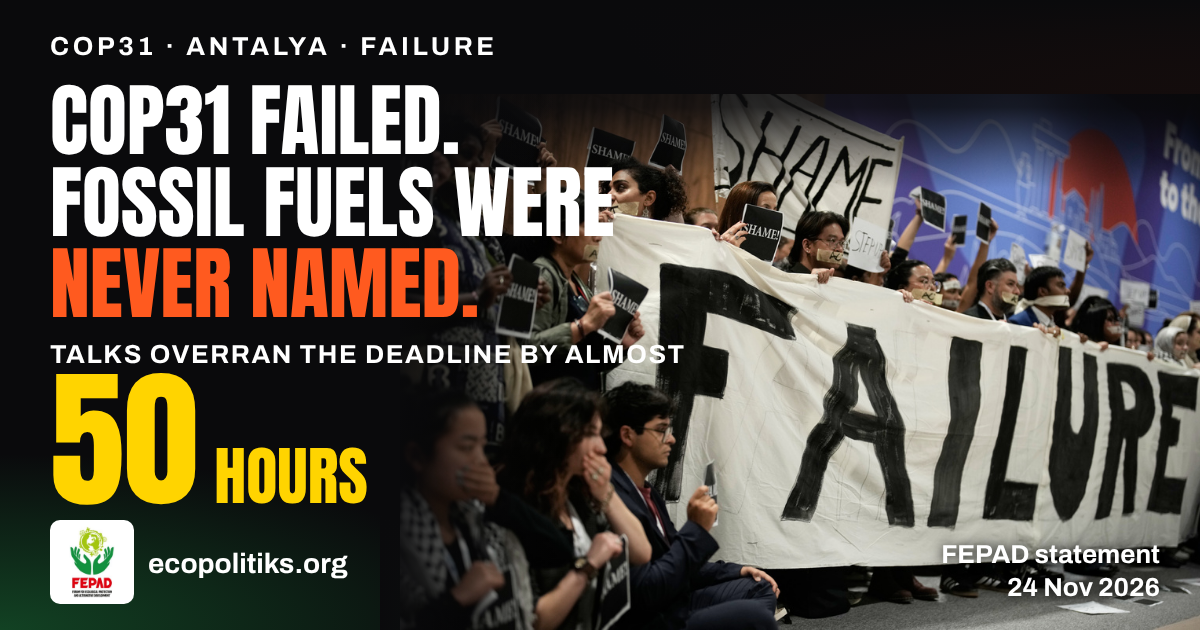
COP31 at Antalya has ended without its main agreement. Negotiations ran almost 50 hours past the scheduled close and still stalled on fossil fuels, climate finance and the 1.5°C overshoot. It is the first UN climate summit since Copenhagen in 2009 to fail to adopt its main cover decision. The Antalya Pact was rejected in the final hours by the EU, the UK and several climate-vulnerable nations, though some negotiated items were still adopted.
The draft did not mention fossil fuels, the main driver of the crisis. Ireland’s minister, speaking for the EU, said the conference had been “hijacked” by some oil states. The resistance to fossil fuel language was visible from the first week. Saudi Arabia and Russia have traditionally resisted such language, while large developing economies such as India oppose measures they say could limit their development. On November 16, the Arab Group and the Russian Federation rejected the draft text, opposing language that targets specific energy sources. The Hindu reports that Saudi Arabia, China and India favoured the final cover text as framed.
The rich countries are equally guilty on finance. A revised draft dropped the $120 billion adaptation finance target for developing countries. The Adaptation Fund raised barely $50 million against a target of $300 million a year, according to The Wire. UN findings showed that requests for assistance with loss and damage exceeded available funds eightfold. Meanwhile Germany, now the largest developed-country contributor, cut its public budgetary climate finance by 23 per cent, from EUR 6.1 billion in 2024 to EUR 4.7 billion in 2025.
At the opening plenary, the standalone Climate Finance Work Programme, a key demand of developing countries, was adopted despite objections from the EU. Proposals for separate discussions on tripling adaptation finance were dropped. The US, a major oil consumer, did not attend COP31 at all. India’s delegate said developed partners had told developing countries that finance was “dead in the water”. The Marshall Islands said its partners had arrived with “empty hands”.
The Like-Minded Developing Countries also warned that equity and common but differentiated responsibilities were diluted. They asked whose emissions, past and continuing, have exhausted the carbon budget. This is a fair question, and the Global North has not answered it.
India must also look at itself. India is the world’s third-largest fossil CO2 emitter, at about 8 per cent of the global total. The Global Carbon Budget 2026 projects that India’s carbon emissions will rise by 4.4% this year, even as global fossil emissions dip marginally. India’s per capita emissions are low and its demand for equity is just. But a country that stands with Saudi Arabia and China against naming fossil fuels, while its own coal-based emissions grow, weakens its own moral case.
FEPAD demands that fossil fuels be named and phased out, with the rich countries moving first. Adaptation and loss-and-damage finance must have baselines, figures and deadlines. India must set a credible path away from coal, and not shelter behind the sins of others.
Behind all these differences lies a common cause. The governments of the US, China, Russia, Saudi Arabia, the European Union and India differ in form and in rhetoric, but the force that shapes their policies is transnational corporate capital, whose only aim is profit at any cost. Fossil fuel, finance and big industry capital cut across national borders, and governments in each country, in varying degrees, work within its limits. That is why fossil fuels disappear from the text, why finance is watered down, and why the poor are told to wait. States ruled by corporate capital cannot solve a crisis created by the pursuit of profit, and COP31 has proved it once again. The answer will not come from summit rooms alone. It must come from people’s movements for ecological protection and an alternative path of development that puts people and nature before profit.
Jayarajan C.N.
for Forum for Ecological Protection and Alternative Development (FEPAD)
