
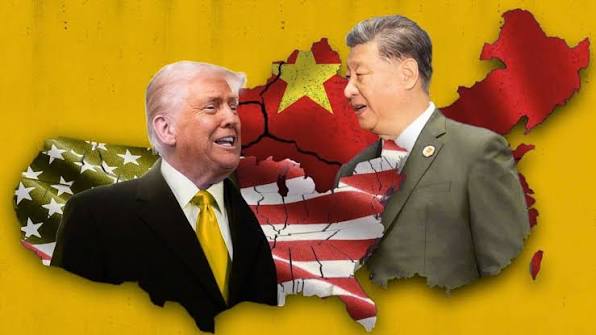
Xi Jinping Invokes “Thucydides Trap” to Justify Sino-US Imperialist Collusion!
P J James
Alternation between competition for global dominance and collusion for plunder of world people and resources is inherent in inter-imperialist contradictions. This dialectic between collusion and competition which are the twin and two sides of the same coin, is all the more significant in a critical situation of shifting imperialist power balance. Obviously, when the already overstretched and strained US imperialism is on the decline, the rising Chinese imperialism is coming forward demanding a greater share of markets and ‘neocolonial spheres of influence’. It is in this context that Chinese president Xi invokes the “Thucydides Trap” (the term describing the dangerous tension that occurs when a rising power threatens to displace an already established superpower) and warns Trump to overcome the risk of war and coexist through collusion that would facilitate global plunder by both. As such, what the world witnessed at the high-profile Trump-Xi Summit at White House during 24-26 September 2026, is a deal and mutual setting of the ‘rules of the game’ between the US and China, the descending and ascending superpowers respectively, for intensified super-exploitation of the workers, oppression on the world people and hitherto unknown levels of corporate plunder of nature. Xi’s own statement that the Chinese goal of “national rejuvenation” and Trump’s “Make America Great Again” (MAGA) agenda can coexist and mutually reinforce one another, amply reveals the collusion or high-level deal-making between the two superpowers for joint global plunder and mutual sharing of the booty. And, Trump’s eulogy for his “great friendship” with Xi in turn, also underscores the collusion and cooperation between the two for prioritising the power of both over world people’s interests.
Of course, regarding a series of issues such as the Sino-US contradictions on Taiwan (despite Trump’s temporary pausing of a $14 billion arms package for Taiwan), China’s oil import from Iran, Artificial Intelligence, critical rare earth minerals, trade in semi-conductor equipment and micro-chips and so on, the Sino-US inter-imperialist contradictions are continuing unresolved. However, the spirit of inter-imperialist cooperation and collusion was self-evident from the State Dinner hosted by Trump on 24 September itself. For, in the banquet, while Xi was accompanied by two dozen senior Party bureaucrats and billionaires representing Chinese ‘State Monopoly Capitalism’ (or Chinese imperialism) Trump and White House staff were joined by CEOs and heads of leading US financial-tech giants including SpaceX, Nvidia, Meta, Apple, Goldman Sachs, New York Stock Exchange, OpenAI, Google, Amazon, General Motors, ExxonMobil, FOX news, Visa, Mastercard, Citigroup, Qualcomm, Pfizer and so on. In essence, this dinner/banquet itself became the concrete expression of an unholy collusion/merger between neofascist Trump regime and Chinese bureaucratic state monopoly capitalism, the material basis both being the most reactionary corporate finance capital under 21st century internationalisation of capital. No doubt, while inter-imperialist contradictions are bound to sharpen as per the logic or laws of motion of capital, what unravelled through the Xi-Trump Summit was a sincere negotiation for a truce to avoid a direct military conflict which would be suicidal for both.
In fact, this unholy deal between both US and China is not at all new. Of course, during the period 1949-1972, on account of China’s staunch anti-imperialist positions, the US imperialism did not even formally recognise the People’s Republic of China (PRC) led by Communist Party of China (CPC), and the US that maintained full diplomatic relations with Taiwan, even blocked China’s entry into the UN. However, taking advantage of the Sino-Soviet split in the beginning of the 1970s, China laid down red carpet for the visit of Nixon to Beijing in 1972, leading to PRC’s recognition as the legitimate government of China and consequent entry into the UN and the Security Council, followed by the formulation of the notorious Three World Theory by CPC in 1973-74 identifying Soviet Union as the world’s number one enemy. It made a sea-change in Sino-US relations, and both cooperated each other against Soviet Union including the Chinese withdrawal of its troops from Vietnam, for appeasing the US. Following full-fledged capitalist restoration in China since the 1980s, along with ever-intensifying trade relations, US MNCs flocked to China to take advantage of China’s inexorable source of cheap labour. And following China’s entry into WTO and integration with global political economy, the US gave China the Most Favoured Nation (MFN) designation in 2001.
And, since the turn of the 21st century, and more specifically after the “Global Meltdown” or World Economic Crisis of 2007-08, China has emerged as a powerful imperialism though its notions and modus operandi are different from that of Western imperialism. What we witness in the post-Cold War neoliberal-neofascist context is a shake of US-led imperialist world system. The inherent logic of capital has already transformed US stature as the world’s leading imperialist power. Its role as the largest manufacturer and biggest trader has been lost to Chinese imperialism. In spite of having around 750-800 military bases across 80 countries of the world, US imperialism is lacking the material basis to maintain it, and has been backtracking from its international commitments, especially to UN-affiliated institutions, which, to an extent, were political tools propped up by US itself that enabled it to carry on the tasks as postwar neocolonial hegemon. On the other hand, with its well-defined lead over “frontier technologies” associated with so called “Fourth Industrial Revolution”, Chinese imperialism today has 24 “innovation hubs” among WIPO’s (World Intellectual Property Organisation) top 100, whereas US is far behind it. China is the undisputed manufacturing powerhouse with 30 percent of world industrial output, while the US holds only around 15 percent.
To be precise, Washington’s bullying tariffs and financial blockades (amid the trend towards de-dollarisation) are becoming less effective against China. In this context, though Sino-US inter-imperialist contradictions are sharpening, both US and China, with varying perceptions between both, are keen to have a truce instead of an open confrontation. This is the immediate context that led to a Sino-US collusion at the White House. However, irrespective of whether the US is replaced by a China-led bloc or a multipolar global order, unless a political alternative from the perspective of the workers and oppressed peoples is put forward by the International Left, the crisis confronting humankind will continue without any let up. To take up this task in the proper way, ideological-political clarity on 21st century imperialism and proper understanding of its operations are of utmost importance.
