
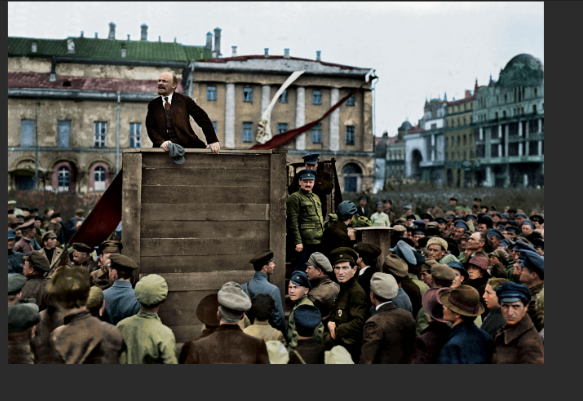
“Great October Socialist Revolution,” on 7 November 1917, was the first successful capture of power by the proletariat in history under the leadership of the Communist Party. It resulted in the establishment of a Soviet Socialist Republic under Lenin’s leadership.
Soviet Union’s advancement through revolutionary socio-political and economic policies coupled with its progressive foreign policy-relations inspired the working class and oppressed peoples the world over. The establishment of Comintern (Communist International) in 1919 and the adoption of “Workers and Oppressed Peoples of the World, Unite” as its clarion call under Lenin’s initiative in the Second Congress of the Comintern in 1920, inspired the working and oppressed peoples not only in imperialist countries, but also in colonies and semi-colonies. It led to the formation of Communist Parties across the world, including that in India and China in the 1920s.
This also brought the liberation of the working class and all oppressed to the agenda of world politics as a central question for the first time. It was this context that prompted the reactionary capitalist forces in the so called Western democracies, who feared the spread of progressive and socialist ideals among world people, to resort to fascism declaring Communism as their number one enemy. Meanwhile, the contradictions among colonial powers for grabbing colonies and control over them during this period led to Second World War. However, led by Comintern and Soviet Union together with National Liberation Movements, the fascist forces could be defeated together with the ending of the World War.
However, the weakening of the old colonial powers including Britain and the consequent “decolonisation” enabled US to lead post-war imperialism by replacing old colonialism with more “pernicious and sinister” neocolonialism. Along with intensifying all-around anti-Communist offensive, US imperialism also succeeded in installing military regimes in several countries from the Americas to Asia-Pacific during the immediate postwar period. Together with unleashing Cold War against Soviet Union and its allies, US imperialism also established military arrangements such as NATO, and created almost 800 overseas military bases across around 80 countries. As an ideological weapon against Communism and to divert world people’s attention to reformist channels, US-led imperialist think-tanks also conceptualized the ‘welfare state’ that continued for almost a quarter century following Second World War.
However, instead of rising to the occasion and appropriately chalk out the international tasks from a proletarian ideological-political perspective, the ICM started tailing behind the global developments. In continuation of the strategic mistake of the Dissolution of the Comintern in 1943, the International Communist Movement (ICM) faced ideological setbacks including the failure to concretely evaluate neocolonialism as a qualitatively different phase of imperialism and accordingly comprehend the postwar laws of motion of imperialist finance capital. To be precise, this led to the ascendance of revisionism in Soviet Union followed by left sectarianism in China, resulting in their transition to capitalist path, doing immense harm to ICM.
Meanwhile, the so called “golden age of capitalism” based on state-led development ended by the beginning of the 1970s, and the inherent crisis of imperialist world system reached a higher level in the form of ‘global stagflation’. In fact, to overcome the crisis of the 1930s, capitalist regimes had to initiate state intervention (later eulogised as welfare state) by imposing a series of controls over speculative capital and its free market operations. This was in the context of the advancement of ICM led by Soviet Union. However, during the onset of the crisis of the 1970s, the ICM had already started facing many ideological-political setbacks. Taking advantage of this, US led imperialism abandoned welfare capitalism and embraced neoliberalism that removed all controls on financial speculation such that today, productive sphere now comprises a minor portion of global GDP or, as analysts say, production is like a “bubble in a whirlpool” of speculation.
Intensification of neoliberalism over Afro -Asian Latin American countries got added dimension with the establishment of WTO in 1995. And, together with IMF-World Bank diktats and facilitated by internationalisation of capital and production, new technologies and new global division of labour, neocolonial plunder and loot reached horrific proportions by the turn of the 21st century. However, even after unprecedented super-exploitation of workers and plunder of nature, the crisis associated with accumulation mounted further as manifested in the so called “sub-prime crisis” of 2007-08. This again led to a far-right turn in neoliberal policies as manifested in hitherto unknown levels of wealth concentration with a handful of corporate billionaires, frightening inequality, poverty, unemployment and enviromental catastrophe. This resulted in resistance of workers, peasants and other oppressed sections against neoliberal-corporatisation at a global level.
As workers and all oppressed are coming up against super exploitation and multidimensional oppression, the most corrupt corporate finance capital and its political leadership are now unleashing neofascism (fascism in the neoliberal period) everywhere, based on the historical and cultural specificities of countries. That is, while the material basis of neofascism everywhere is the most reactionary corporate capital, it is capable to use racism, ehnonationalism, Evangelism, Zionism, political Hinduism (Hindutva) political Islam, Buddhism and so on as ideological bases for neofascism, according to the concrete situation of countries. Along with Communism, it’s old enemy, in the post Cold War neoliberal period imperialism has also projected Muslim identity as it’s new enemy. As such, both anti-Communism and anti-Muslimness or Islamophobia have become common ideological denominators of various hues of neofascists.
Obviously, India the most populous country today is a typical example of neofascism. The BJP that continuosly rules India for more than a decade is a political tool of RSS, the biggest and longest-running fascist organisation in history. As part of RSS’ majoritarian Hindurashatra agenda, the religious minorities, especially Muslims, are targeted and wantonly attacked, even as efforts are in full swing to deny citizenship right to Muslims. Since Manusmriti, the ideological basis of RSS, treats Dalits and women as subhuman, they are also stigmatised and even being denied the minimum demcratic rights enshrined in the Constitution for them. And the RSS/BJP is against conducting a Caste Census that will give concrete data on the caste-based hold over India’s economy and political/administrative power.
Today when we commemorate October Revolution, the entire world including India is at a critical juncture of far-right neofascism propped up by globalised finance capital. And the most important lesson that have to learn from October Revolution is to grasp the ideological-political context that made it possible. It was Lenin’s analysis of imperialism and finance capital that exposed the Tsarist regime of Russia as a weak link of imperialism which enabled Bolsheviks to overthrow it. Viewed in this perspective, the most crucial task on the part of Communists today is to have ideological clarity on twenty-first century imperialism and fascism and to develop political practice based on that.
Since October Revolution which which was in the second decade of twentieth century, today imperialism and finance capital have undergone many qualitative transformations. Similar is the case with classical fascism of the colonial period versus twenty-first century neofacism. That is, today’s imperialism and fascism are not text copies or stereotyped versions of the past, and the situation today is extremely complex that requires concrete analysis according to the concrete situation, as Lenin said. To be precise, Communists can move forward only by developing ideological clarity on today’s imperialism and neofascism and political practice based on that understanding. Commemoration of October Revolution becomes relevant only from this perspective.
P J James
General Secretary
CPI (ML) Red Star
New Delhi
01.11.2024
